The benefits of an apochromatic refractor
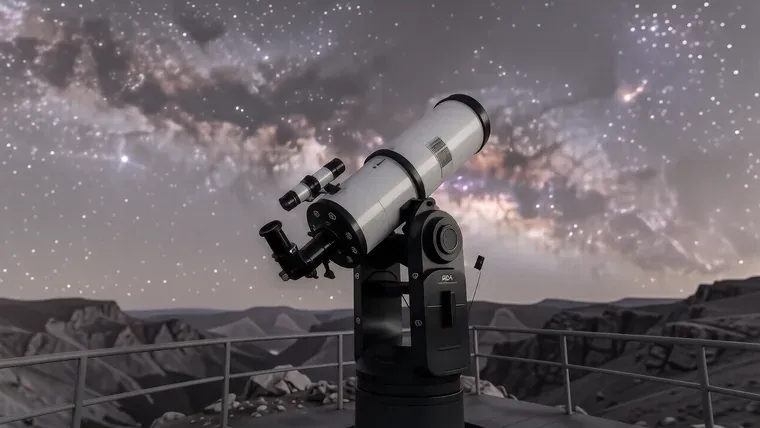
An apochromatic refractor is an optical instrument that uses three or more lens elements to bring three wavelengths of light—typically red, green, and blue—into a single common focus. This design eliminates the colored fringes, known as chromatic aberration, that plague simpler achromatic telescopes. While achromatic refractors use two lenses to correct two colors, apochromats achieve much higher precision by incorporating extra-low dispersion (ED) glass.
The Physics of Color Correction
Light behaves like a wave. Different wavelengths travel at different speeds through glass. This phenomenon causes white light to split into a spectrum when passing through a single lens. In a basic refractor, this results in a purple or blue halo around bright objects like the Moon or Jupiter. Such an effect is frustrating for observers.
Achromatic lenses attempt to fix this using two elements. They bring red and blue light to the same focal point, but the green wavelength remains slightly out of alignment. This creates a residual color error. Apochromatic designs solve this problem through complexity. By adding a third lens element made of specialized ED glass, the telescope can align three primary colors at the same point.
The precision of an apochromat is measurable. While a standard achromatic refractor might show significant color fringing at high magnifications, an apochromat provides a tight, clean point of light. This is essential for high-resolution work. If you are observing a star with a magnitude of 1.0, the absence of chromatic error allows for a much sharper diffraction pattern.
The math behind these lenses is difficult. Manufacturers must calculate the refractive index and dispersion of each glass type to ensure all wavelengths converge. Because the tolerances are so tight, even small temperature shifts can affect performance. Most high-end apochromats are designed with heavy metal housings to maintain mechanical stability during long nights of observation.
- Achromatic refractors: Two lenses, two colors corrected.
- Apochromatic refractors: Three or more lenses, three colors corrected.
- ED glass: Essential for minimizing dispersion.
Historical Context of Refracting Optics
Refractors were the first tools used to probe the heavens. Galileo Galilei utilized a simple refracting telescope in 1610 to identify the four largest moons orbiting Jupiter. These satellites changed our understanding of the solar system forever. He saw them not as stars, but as distinct bodies orbiting another world.
The evolution of the refractor moved toward correcting optical flaws. In 1861, using Dearborn’s 18-inch refractor telescope, astronomers discovered that Sirius had a small stellar companion. This discovery proved that even the brightest stars could have hidden partners. It required precise optics to separate the two light sources.
As technology progressed, larger and more complex refractors emerged. The Yerkes Observatory houses a famous refractor with a diameter of 101.6 centimeters (40 inches). This instrument was a marvel of its time. It demonstrated that increasing aperture and improving lens design could reveal much deeper details in the cosmos.
Other significant historical milestones include:
- March 25, 1655: Christiaan Huygens discovered Titan, the largest moon of Saturn.
- August 12, 1877: Asaph Hall found Deimos at the U.S. Naval Observatory in Washington, D.C.
- September 9, 1892: Edward Emerson Barnard discovered Amalthea, a moon of Jupiter, using a 36-inch (91 cm) refractor at Lick Observatory.
The transition from single-element lenses to sophisticated doublets and triplets allowed for the discovery of the interstellar medium. In 1904, Professor Hartmann used the Potsdam Great Refractor to determine that this medium contained calcium. He reached this conclusion by observing the double star Mintaka in the Orion constellation. This was a major step in understanding what exists between the stars.
Modern Apochromatic Instruments
Today, apochromatic refractors are the primary choice for astrophotographers. They offer wide, flat fields of view that are necessary for large camera sensors. A wide field is helpful because it allows for the capture of large nebulae without significant distortion at the edges of the frame.
Small-aperture apochromats are common for portable use. For example, the Levenhuk Ra R66 ED Doublet is a compact option with a 66 mm aperture and a 400 mm focal length. It uses low dispersion optics to provide high contrast. These small units are often used for “field trip” photography where weight is a factor.
Larger or more specialized models exist for dedicated imaging. The Levenhuk Ra FT72 ED features a 72 mm aperture and a 432 mm focal length. It uses a two-element design with ED glass to ensure minimal chromatic aberration. Many users find that these small, high-quality refractors can actually function as high-end digital camera lenses when attached to a DSLR or mirrorless body.
There are several variations in modern consumer gear:
- Carbon fiber housings (like the Ra R66 ED Carbon) reduce weight and improve thermal stability.
- Achromatic models (like the Discovery Spark 709 EQ) provide lower cost for beginners but suffer from color fringing.
- ED Doublets (like the Ra R80 ED) offer a middle ground between basic achromats and expensive triplets.
The choice of mount is as important as the telescope itself. An equatorial mount allows the telescope to track the rotation of the Earth by moving in a single axis. This is vital for long-exposure photography. If the tracking is not precise, stars will appear as streaks rather than points.
Comparing Achromats and Apochromats
An achromatic refractor is often more affordable. It is a good entry point for someone who only wants to look at the Moon or bright planets. The Levenhuk Blitz 80 PLUS is an example of such a device. It is designed for beginners who want to see lunar craters clearly without spending thousands of dollars.
However, the limitations are clear once you move to deep-sky objects. An achromat will show a purple glow around a bright star in a nebula. This can obscure fine details in the gas clouds. An apochromat removes this glow so that the colors of the nebula appear as they truly are.
The difference is most noticeable in professional or semi-professional settings. Apochromats are used for positional astronomy and high-resolution imaging. While an achromat might suffice for visual observation through an eyepiece, it often fails when paired with a sensitive CCD or CMOS camera. The sensor will pick up every bit of uncorrected light.
| Feature | Achromatic Refractor | Apochromatic Refractor |
|---|---|---|
| Lens Elements | Typically 2 | 3 or more |
| Color Correction | Two wavelengths (Red/Blue) | Three wavelengths (RGB) |
| Primary Use | Visual Moon/Planet viewing | Astrophotography/High-res imaging |
| Price Point | Lower | Higher |
| Chromatic Aberration | Present (Purple/Blue halos) | Minimal to none |
The cost of an apochromat is higher because ED glass is expensive to manufacture. It requires precise melting and polishing processes to ensure the dispersion properties are consistent throughout the lens. This investment pays off in image clarity.
Selecting Gear for Specific Tasks
If your goal is purely visual, a larger achromatic refractor might be better. You get more aperture for your money. A 102 mm achromat will show more detail in Saturn’s rings than a 70 mm apochromat, even if the colors are not perfectly corrected. The light-gathering power of the larger lens is a significant advantage.
For astrophotography, you should prioritize the apochromatic design. The flatness of the field is critical. Many refractors suffer from “field curvature,” where the center of the image is in focus but the edges are blurry. High-end apochromats often include a field flattener to correct this.
Consider your portability needs as well. A compact tube like the Levenhuk Ra R66 ED is easy to carry to dark sites. Many astronomers prefer traveling to areas with low light pollution. In these locations, the sky is much darker, which allows for better contrast when observing faint objects.
When choosing a telescope, keep these factors in mind:
- Aperture: Determines how much light you collect.
- Focal Length: Affects the magnification and field of view.
- Optical Design: Achromat vs. Apochromat.
- Mount Type: Azimuthal for simplicity or Equatorial for tracking.
A beginner might start with a Discovery Sky Trip ST80. It is small and designed for travel. As they gain experience, they may move toward an ED doublet or triplet to handle the demands of imaging. This progression is common in the hobby.
The relationship between the telescope and the camera is vital. If you use an apochromat with a high-resolution sensor, the lens becomes the bottleneck. You must ensure that the mechanical stability of the mount can support the weight of the camera without vibrating. Even a small breeze can ruin a long exposure.
Most modern enthusiasts eventually seek out ED glass. The clarity it provides is difficult to ignore once you have seen it. Whether you are looking at the craters of the Moon or the distant reaches of the Orion Nebula, the quality of your optics defines the experience.
Frequently asked questions
What is the main difference between an achromatic and an apochromatic refractor?
An achromatic refractor uses two lenses to correct two wavelengths of light, while an apochromatic refractor uses three or more lens elements to align three primary colors (red, green, and blue) at a single focus.
Why is ED glass important in telescope design?
Extra-low dispersion (ED) glass is essential for minimizing chromatic aberration, allowing the telescope to achieve much higher precision and tighter points of light compared to standard glass.
Which type of refractor is better for astrophotography?
Apochromatic refractors are preferred for astrophotography because they provide wide, flat fields of view and eliminate the purple or blue halos that can obscure fine details in nebulae.
What are the advantages of using an equatorial mount?
An equatorial mount allows a telescope to track the Earth's rotation by moving in a single axis, which is vital for preventing stars from appearing as streaks during long-exposure photography.
More in Stargazing
How to start choosing the perfect telescope for beginners
Learn how to select the right telescope by comparing refractors and reflectors, understanding aperture, and matching equipment to your observation goals.
Differentiating between refractor and reflector telescopes
Learn the key differences between refractor and reflector telescopes to choose the right optical design for planetary viewing or deep-sky observation.
A beginner's guide on how to use Stellarium
Learn how to use Stellarium to simulate the night sky, configure geographical coordinates, and optimize visual settings for celestial observation.
How a refractor telescope works
Learn how a refractor telescope uses lenses to gather light, its advantages in contrast and maintenance, and how APO designs correct chromatic aberration.