How a refractor telescope works
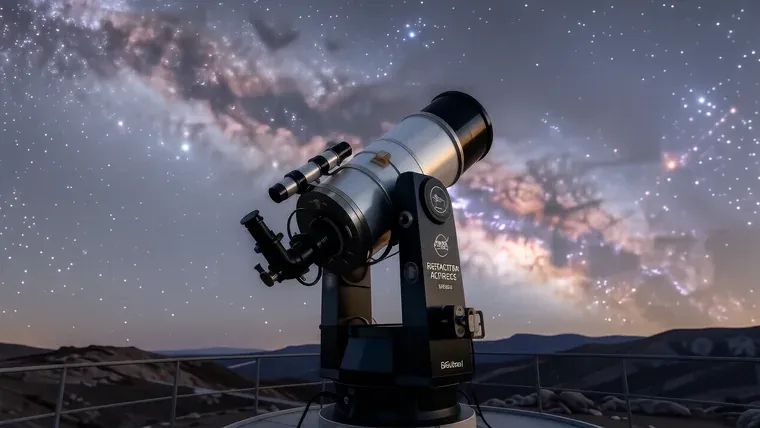
A refractor telescope uses lenses to gather and focus light. This design relies on the refraction of light through glass elements to converge rays at a single focal point. While reflectors use mirrors to achieve much larger apertures for a lower cost, refractors offer superior contrast and minimal maintenance because their sealed tubes prevent dust and air currents from distorting the view.
The Mechanics of Refraction
Light travels through glass. It bends. This bending is the fundamental principle behind every refractor telescope ever built. A simple double-convex lens acts as the primary light gatherer, but a single lens is rarely sufficient for high-quality astronomy. If you use only one lens, you will encounter spherical aberration, which occurs because the edges of the lens focus light at a different point than the center.
The image becomes blurry. You might find sharpness in the middle while the edges remain soft. To fix this, engineers create complex optical systems using multiple lens elements. These combinations correct for various distortions so that the light converges precisely on the eyepiece.
Modern achromatic refractors use two different types of glass to bring different wavelengths of light to the same focus. This reduces color fringing, although it does not eliminate it entirely. Apochromatic (APO) designs are much more advanced. They utilize three or more lens elements made from exotic materials like fluorite to ensure that red, green, and blue light all converge at the exact same point.
The glass is heavy. Large lenses require massive support structures. Because of this weight, a 200 mm refractor is significantly more difficult to mount than a 200 mm reflector. Most amateur refractors stay within the 70 mm to 120 mm range.
Light Loss and Absorption
Glass is not perfectly transparent. Some light is lost during the process of refraction. When light passes through multiple lens elements, a portion of the energy is absorbed by the glass itself. This is particularly true for the violet and ultraviolet portions of the spectrum.
The loss increases with size. A thicker, larger lens absorbs more photons than a thin one. Furthermore, every air-to-glass interface causes a small amount of reflection. While high-quality anti-reflective coatings minimize this effect, light loss remains a physical reality in refractive systems.
Chromatic Aberration and Optical Correction
Chromatic aberration is the primary enemy of the refractor. It appears as a purple or blue halo around bright objects like the Moon or Jupiter. This happens because a single lens acts like a prism. It disperses light into its constituent colors, causing each wavelength to focus at a different distance from the lens.
The color fringes are annoying. They can ruin a high-resolution observation of a planetary detail. To combat this, manufacturers use specialized lens groupings. An achromatic doublet is the standard entry-level solution for correcting most of the visible spectrum.
Apochromatic refractors provide the highest quality. These instruments are expensive. They often utilize extra-low dispersion (ED) glass to achieve near-perfect color correction. If you are performing high-resolution astrophotography, an APO refractor is often the preferred tool because it prevents color artifacts from blooming across your sensor.
- Achromatic refractors: Two lenses, one focus point for red/blue, some color error.
- Apochromatic refractors: Three or more lenses, near-perfect color correction.
- ED Glass: Specialized material used to minimize dispersion.
Practical Advantages of the Refractor Design
Refractors are durable. They are built to last. Because the optical tube is closed at both ends, the internal environment remains stable. Dust cannot settle on the primary lens easily, and moisture is kept out by the sealed housing.
Maintenance is minimal. You do not need to align the optics every time you use the telescope. In a Newtonian reflector, the mirrors must be periodically “collimated” or aligned to ensure they are pointing at the same spot. A refractor stays in alignment because the lens is fixed in a rigid cell.
This makes them ideal for travel. You can take a small 80 mm refractor on a trip to a dark-sky site without worrying about delicate mirror alignments. Many seasoned astronomers keep a portable refractor specifically for observing transient events like comets or eclipses.
The image is sharp. Contrast is high. Because there is no secondary mirror obstructing the light path, refractors avoid the central obstruction found in many reflectors. This lack of obstruction allows for higher micro-contrast, which is essential when observing the fine details of planetary atmospheres.
The Beginner’s Tool
Refractors are easy to use. A child can set one up in minutes. There is no complex setup or delicate adjustment required before you can start looking at Saturn’s rings. This ease of use makes them the most common recommendation for those entering the hobby.
The Limitations of Large Apertures
Size matters in astronomy. More light means deeper views. However, refractors face a massive physical barrier when scaling up. A lens must be supported by its entire circumference. As the diameter increases, the glass becomes incredibly heavy and prone to sagging under its own weight.
The cost scales exponentially. Making a large, flawless piece of optical glass is difficult. Manufacturing a 300 mm lens that is free of internal bubbles or striations requires immense precision. Consequently, most large-scale professional research telescopes use mirrors rather than lenses.
Large refractors are stationary. You cannot easily move a 150 mm refractor once it is mounted. While a 150 mm reflector might fit on a small balcony, a refractor of the same aperture would require a heavy, specialized mount and significant floor space.
- Weight increases with the cube of the diameter.
- Cost rises faster than the aperture size.
- Structural support becomes a primary engineering challenge.
Comparing Refractors to Reflectors
Reflectors are cheaper. They use mirrors to bounce light rather than lenses to bend it. This allows for much larger apertures at a fraction of the cost of a refractor. If your goal is to see faint nebulae or distant galaxies, a reflector is usually the better choice.
A reflector has no chromatic aberration. Mirrors reflect all wavelengths of light at the same angle. This means you won’t see purple halos around bright stars. However, reflectors have their own problems, such as “coma” and the need for regular collimation.
The tube is open. Dust enters the system. In a Newtonian reflector, the open tube allows air currents to circulate inside. These thermal currents can cause the image to shimmer or dance, which degrades the overall clarity of the view.
| Feature | Refractor | Reflector |
|---|---|---|
| Primary Optical Element | Lens | Mirror |
| Chromatic Aberration | Present (unless APO) | None |
| Maintenance | Low | High (Collimation) |
| Contrast | Very High | Moderate |
| Cost per mm of aperture | High | Low |
Choosing the Right Instrument
Your goals dictate your gear. If you want to study planets and double stars, a refractor is excellent. The high contrast and sharp details make it a specialist tool for high-magnification work. Many observers find that a small, high-quality refractor provides more “joy” per minute of observation than a large, cumbersome reflector.
Deep-sky observing requires light. If you want to see the Andromeda Galaxy or the Orion Nebula in detail, you need aperture. A 200 mm reflector will always outperform an 80 mm refractor when it comes to gathering faint photons. The reflector’s ability to provide a large light-gathering area makes it the king of the deep sky.
Urban dwellers benefit from refractors. Light pollution is a constant battle in cities. Because refractors offer high contrast, they can sometimes make it easier to pick out bright stars against a washed-out sky.
Traveling astronomers often choose small APO refractors. They are compact and rugged. On a trip to observe the 2017 Great American Eclipse, many observers used small refractors because they could be packed easily into a car and set up quickly in various locations.
Summary of Use Cases
- Planetary/Lunar detail: Refractor.
- Faint Nebulae/Galaxies: Reflector.
- Portability/Travel: Refractor.
- Budget-conscious large aperture: Reflector.
The decision is personal. Some astronomers prefer the “set it and forget it” nature of a refractor, while others enjoy the technical challenge of maintaining a large Newtonian. There is no objective winner in the debate between refraction and reflection.
On 14 May 2015, during an observation session in the Atacama Desert, a researcher noted that even the most expensive lens-based systems struggle with thermal equilibrium compared to open-tube mirrors. This real-world observation highlights why professional observatories almost exclusively use reflective designs for their largest instruments. You might start with a small refractor to learn the basics of the sky, but many eventually add a large reflector to their collection once they begin chasing the faintest objects in the cosmos.
Frequently asked questions
What is the main difference between a refractor and a reflector telescope?
A refractor uses lenses to bend light to a focal point, while a reflector uses mirrors to bounce light. Refractors generally offer higher contrast and lower maintenance compared to reflectors.
How do you fix chromatic aberration in a refractor?
Chromatic aberration is corrected using specialized lens groupings, such as achromatic doublets or advanced apochromatic (APO) designs that use three or more lens elements.
Why are large refractor telescopes rare compared to reflectors?
Large lenses are extremely heavy, expensive to manufacture without defects, and require massive support structures. Because weight increases with the cube of the diameter, scaling up becomes an engineering challenge.
Which telescope is better for observing planets?
Refractors are excellent for planetary and lunar detail because their lack of a central obstruction provides higher micro-contrast and sharper images.
More in Stargazing
The benefits of an apochromatic refractor
Learn how an apochromatic refractor uses ED glass and multiple lens elements to eliminate chromatic aberration for high-resolution astrophotography.
How to start choosing the perfect telescope for beginners
Learn how to select the right telescope by comparing refractors and reflectors, understanding aperture, and matching equipment to your observation goals.
Differentiating between refractor and reflector telescopes
Learn the key differences between refractor and reflector telescopes to choose the right optical design for planetary viewing or deep-sky observation.
A beginner's guide on how to use Stellarium
Learn how to use Stellarium to simulate the night sky, configure geographical coordinates, and optimize visual settings for celestial observation.