An overview of the functioning of the solar system
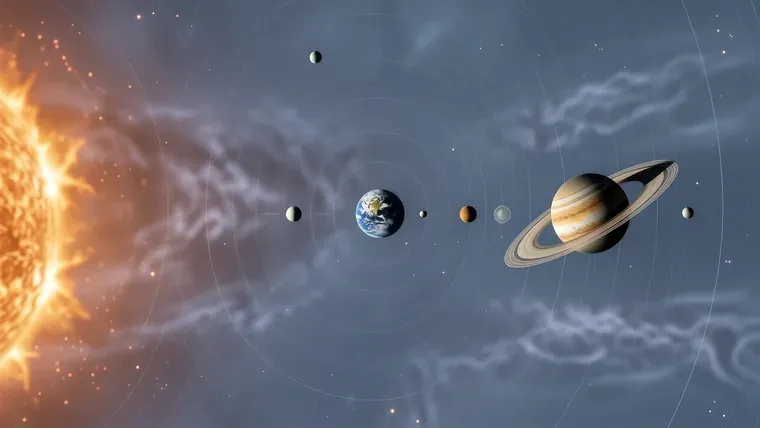
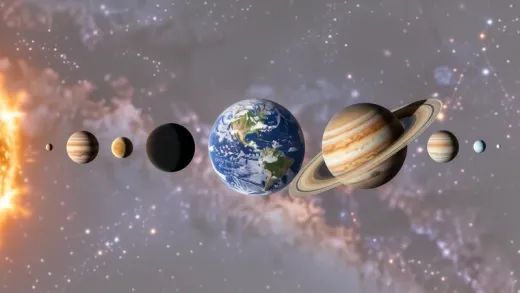
The solar system consists of the Sun and all celestial bodies bound to it by gravity, including eight planets, numerous dwarf planets, moons, asteroids, and comets. This system formed approximately 4.6 billion years ago from the gravitational collapse of a molecular cloud within the Orion arm of the Milky Way galaxy. While the Sun contains more than 99% of the system’s total mass, the remaining matter follows elliptical orbits aligned with the invariable Laplace plane.
The Solar Nebula and Stellar Birth
The solar system began as dust. It was a spinning cloud. This process, known as the nebular hypothesis, suggests that a massive interstellar cloud collapsed under its own gravity so that the density increased at the center to form a protostar. Scientists like Pierre-Simon Laplace proposed these early models in the 18th century. The cloud rotated. It flattened into a disk.
Heat rose rapidly. As particles within the protoplanetary disk collided and interacted with increasing intensity, the temperature of the system rose until it reached millions of Kelvin. This heat triggered thermonuclear fusion. Hydrogen atoms fused into helium at the core because the pressure became intense enough to overcome electrostatic repulsion. The Sun ignited. It became a G2V spectral type star.
The leftover material remained. These fragments formed the planets. While the central star consumed most of the mass, the remaining dust and gas coalesced into larger bodies through accretion. This process took millions of years. Small grains became pebbles. Pebbles eventually grew into planetesimals.
Gravity drove everything. The Sun’s mass dictates the orbital velocity of every object. Although the Sun exerts the dominant force, moons orbit planets because the local gravitational pull of a planet is stronger than the solar pull at those specific distances. Orbits are not perfect circles. They are ellipses.
Terrestrial Planets and Inner Composition
The inner planets are rocky. Mercury, Venus, Earth, and Mars define this group. These bodies possess high densities because they consist primarily of silicate rocks and metallic cores made of iron and nickel. They stay close to the Sun. Their orbits are short.
Mercury is small. It has a radius of 2439.7 km. The planet experiences extreme temperature swings because it lacks a substantial atmosphere to trap or distribute heat. Daytime temperatures reach +510 °C. Nighttime temperatures drop to -210 °C. It is a desert world.
Venus is hot. It is often called Earth’s twin due to similar mass and size. However, its atmosphere contains 96% carbon dioxide and 4% nitrogen, which creates a runaway greenhouse effect. Surface pressures reach 92 times that of Earth. The temperature stays at +434 °C.
Earth supports life. It is the third planet from the Sun. Water covers 70% of the surface because the planet maintains temperatures that allow H2O to exist in liquid form. The atmosphere contains nitrogen and oxygen. Life thrives here.
Mars is red. This color comes from iron oxide on its surface. The planet has a diameter of 6780 km. It possesses two moons, Phobos and Deimos. Mount Olympus sits on Mars. It is an extinct volcano that reaches 21.2 km in height.
Gas Giants and the Outer Reach
The outer planets are massive. Jupiter, Saturn, Uranus, and Neptune comprise the giant group. These worlds lack solid surfaces because their compositions consist mostly of hydrogen, helium, and ices. They sit far from the Sun. Their years are long.
Jupiter is the king. It has a radius of 69911 km. Its mass is 318 times that of Earth. This enormous gravity allows it to host at least 95 moons, including the four Galilean satellites discovered by Galileo Galilei in 1610. It rotates fast. A day lasts 9 hours and 56 minutes.
Saturn has rings. These rings consist of ice and rock particles. Saturn is the least dense planet. It would float in water because its average density is lower than that of liquid H2O. Wind speeds reach 1800 km/h. It has 146 known moons.
Uranus is an ice giant. It appears blue due to methane in its atmosphere. The planet rotates on its side because a massive collision likely knocked its axis nearly 98 degrees from the perpendicular. Temperatures drop to -224 °C. It has 27 moons.
Neptune is windy. It is the eighth planet. Winds reach speeds of 2000 km/h. This is the fastest recorded wind speed in the solar system. It orbits the Sun at a distance of approximately 4.5 billion kilometers. Neptune is dark and cold.
Small Bodies and Orbital Boundaries
Asteroids occupy the middle. The main asteroid belt sits between Mars and Jupiter. It contains an estimated 300,000 objects. These are minor planets. They are rocky debris.
The Kuiper Belt lies further out. It exists beyond Neptune’s orbit. This region contains many icy bodies and dwarf planets like Pluto, Eris, and Haumea. Pluto was reclassified in 2006 by the IAU. It is a dwarf planet now.
Comets are frozen travelers. They consist of ice, dust, and rock. When a comet approaches the Sun, it develops a coma and tail because the solar radiation causes the ice to sublimate directly into gas. They follow highly elliptical paths. They visit rarely.
The heliosphere defines the edge. This bubble is created by solar wind. It extends about 13.5 billion kilometers from the Sun. Beyond this, interstellar space begins. Voyager 1 crossed this boundary in 2012. It is a significant milestone.
Measuring the system is hard. We use parallax and radar. Astronomers calculate distances in Astronomical Units (AU). One AU equals 149.6 million km. This unit simplifies orbital math.
Dynamics of Motion and Observation
Planets move predictably. Most orbit counter-clockwise. Venus and Uranus are exceptions. They rotate in opposite directions because their axial tilts or rotational histories differ from the rest of the planets. This is called retrograde motion.
Orbits are elliptical. Kepler’s laws describe this. A planet moves faster at perihelion. It moves slower at aphelion. The Sun is not at the center of the ellipse, but at one focus.
We observe through light. Telescopes capture reflected sunlight. We use spectroscopy to find chemical compositions. This method identifies hydrogen and helium on Jupiter. It works for distant stars too.
Gravity maintains order. The Sun’s pull keeps planets in line. While gravity governs large orbits, tidal forces affect moons. Tides can heat the interior of moons like Europa. This creates subsurface oceans.
The scale is vast. If the Sun were 7 cm wide, Earth would be 7.6 meters away. Pluto would sit 300 meters from the center. The edge of the heliosphere would reach nearly 1000 kilometers away. Space is mostly empty.
Gravity dictates the path of every comet and asteroid. Even as new objects like Sedna are found at distances of 13 billion kilometers, the fundamental physics of the Sun’s mass remains the primary driver of all local motion.
Frequently asked questions
How did the solar system form?
The solar system formed approximately 4.6 billion years ago from the gravitational collapse of a molecular cloud, a process known as the nebular hypothesis.
What is the difference between terrestrial and gas giant planets?
Terrestrial planets like Earth are rocky with high densities, while gas giants like Jupiter consist mostly of hydrogen, helium, and ices without solid surfaces.
How large is an Astronomical Unit (AU)?
One Astronomical Unit (AU) equals 149.6 million kilometers and is used to simplify orbital mathematics.
Where is the main asteroid belt located?
The main asteroid belt, which contains an estimated 300,000 rocky objects, is situated between the orbits of Mars and Jupiter.
More in Solar System
Calculating the Earth's mass: A complex task
Learn how scientists use the gravitational constant and orbital mechanics to determine Earth's mass of approximately 5.9722 x 10^24 kg.
Discovering the current location of Voyager in interstellar space
Learn about the current location of Voyager 1 and 2, their distances from Earth, and how they navigate the harsh environment of interstellar space.
How many natural satellites does the earth possess?
Explore Earth's celestial companions, from the permanent Moon to transient quasi-satellites and cosmic dust clouds located at Lagrange points.
How many planets orbit the sun in second grade lessons
Learn how many planets orbit the sun and discover key facts about the eight official planets, from Mercury to Neptune, for students and educators.