The solar path and celestial mechanics
The Sun does not rise or set. Earth rotates on its axis from west to east. This rotation creates the illusion of solar movement across the sky. On March 21 and September 23, the Sun rises exactly in the east and sets exactly in the west because the Earth’s tilt aligns perfectly with the equator during these equinoxes. These dates divide the year into equal parts of light and dark.
The Solar Path and Celestial Mechanics
The Sun moves along the ecliptic. This is a great circle on the celestial sphere. While the Sun appears to travel through different constellations, it actually traces a path through the zodiacal belt because Earth’s orbit defines this specific geometry. The Sun passes through 13 constellations if we include Ophiuchus. Most people only recognize the traditional twelve.
The solar path changes daily. It shifts north or south depending on the season. In the Northern Hemisphere, the Sun rises in the northeast during the summer solstice on June 21 because the Earth’s axial tilt of 23.44 degrees directs more light toward the pole. During the winter solstice on December 22, the sunrise moves to the southeast. The path is lower in the sky.
The distance between Earth and Sun varies. It is not a constant value. The orbit is an ellipse. Earth reaches perihelion, its closest point, at approximately 147 million kilometers, while aphelion occurs at roughly 152 million kilometers. This variation affects the intensity of solar radiation received by our planet throughout the year.
The Sun’s position in the galaxy matters. It orbits the center of the Milky Way. The Sun travels at a velocity of 220 kilometers per second. It completes one full galactic revolution every 225 to 250 million years because the gravitational pull of the galactic mass dictates this massive orbital period. We are currently about 24,000 to 26,000 light-years from the center.
The Sun is a star. It contains 99.86% of the solar system’s mass. It is huge. You could fit 9,600,000,000 Earths inside the Sun if you did not compress them, although a more compact arrangement would allow for 1,300,000,000 Earths. The core temperature reaches 15 million °C. This heat drives the entire system.
The Zodiac and Constellation Transitions
The zodiac follows the ecliptic. It is a circle of animals. The Sun resides in Pisces during March. All stars in Pisces are faint. None exceed the 3rd magnitude. The vernal equinox point has shifted from Aries into Pisces because axial precession changes the orientation of Earth’s axis over long timescales.
In June, the Sun enters Gemini. It passes near Pollux and Castor. This period includes the summer solstice. July brings the Sun into Cancer. There are few bright stars here. In August, the Sun moves into Leo. Regulus and Denebola are the brightest stars in this constellation.
The Sun reaches Virgo in September. Spica is the primary star. One of the first quasars was found here. The autumnal equinox occurs in Virgo. October brings the Sun to Libra. This is a small constellation. Only three stars are visible to the naked eye.
Scorpius appears in November. Antares is its reddish star. Zeta Scorpii has a luminosity 400,000 times greater than the Sun. The Sun also passes through Sagittarius. The center of our galaxy lies in this direction. It is a dense region.
The Sun enters Capricorn in January. No bright stars dominate this area. February brings Aquarius. The Sun moves through these regions while Earth completes its steady orbital trek around the central star. This cycle repeats every year.
The zodiac remains a tool for observation. It helps track solar position. Astronomers use these markers to define coordinates.
Latitude and Seasonal Variations
Seasons depend on axial tilt. The tilt is 23.44 degrees. This angle creates different light distributions. In the Northern Hemisphere, summer occurs when the North Pole tilts toward the Sun. In the Southern Hemisphere, the seasons are reversed because the opposite hemisphere receives more direct solar radiation during those months.
The equator has no seasons. Day and night are almost equal. The Sun stays high. At the poles, the phenomenon is extreme. The Sun may not rise for months during the winter solstice. This is called the polar night. In summer, it creates the midnight sun.
The Sun’s altitude changes with latitude. At 50 degrees latitude, the difference is large. On the winter solstice, the Sun reaches only 16.56 degrees above the horizon. It reaches 63.44 degrees on the summer solstice because the tilt maximizes the solar angle during the warmer months.
The tropics are special. The Sun can be directly overhead. At the Tropic of Cancer, the Sun is at the zenith on June 21. This happens only in specific latitudes. If you are north of this line, the noon shadow always points north. This provides a reliable way to find direction.
Shadows provide data. A gnomon can measure solar height. It is a simple vertical object. The shortest shadow occurs at astronomical noon. This helps travelers find north or south. In the Southern Hemisphere, the shadow points north at noon.
The Sun’s path creates “day arcs.” These are visual representations of daily motion. Midsummer arcs are longer than midwinter arcs. The difference in declination between these two paths is 46.88 degrees. This gap defines the seasonal change.
Solar Structure and Energy Production
The Sun is plasma. It has no solid surface. The photosphere is the visible layer. It is about 100 to 400 kilometers thick. Light is emitted here. The temperature is roughly 5,780 °C. This is much cooler than the core.
Energy moves through layers. The core starts the process. Hydrogen converts to helium via fusion. This happens at the center. The radiative transfer zone follows. Photons collide with plasma particles. It can take a million years for a photon to escape because the density of the plasma causes constant scattering.
The tachocline is thin. It sits between the radiative and convective zones. This layer forms the magnetic field. Plasma flows here are intense. The convective zone uses vortices to move energy. Heat rises through these loops.
The chromosphere is the outer atmosphere. It extends 2,000 kilometers up. It glows red during eclipses. The corona is the outermost part. It looks like a halo. It is extremely hot. This heat is difficult to explain because the temperature increases far from the solar surface.
Sunspots appear on the photosphere. They are cooler regions. Magnetic fields cause them. Solar flares release massive energy. These flares produce X-rays and gamma rays. They can trigger magnetic storms on Earth.
The solar wind flows constantly. It moves at 450 kilometers per second. This stream of charged particles fills the solar system. It creates the aurorae. The wind emerges from open magnetic field lines.
Navigating with Solar Position
You can use a watch. This works in high latitudes. Align the hour hand with the Sun. Divide the angle between the hour hand and 12 o’clock by two. This bisector points south in the Northern Hemisphere because the Sun moves from east to west across the southern sky.
Clocks without numbers still work. You must know the time. At 7 a.m., the Sun is in the east. At 1 p.m., it is in the south. Use these points for orientation. This method helps lost travelers. It requires no compass.
A gnomon is reliable. Place it on flat ground. The shadow moves west to east. It moves slowest at midday. This makes measurements easier. You can find the north-south line by observing the shortest shadow.
The analemma shows the yearly path. It looks like a figure eight. This shape results from Earth’s elliptical orbit and axial tilt. If you record the Sun’s position at the same time every day, you will see this pattern emerge. It is a vital tool for solar designers.
In 1978 to 1979, Dennis di Cicco captured an analemma. He used a modified digital alarm clock. He worked in the United States. He took photos at 08:30 EST every week. This required great patience.
The Budapest analemma is real. A photographer named György Soponyai captured it. It was posted on Flickr. The image shows the Sun’s path over a city. It matches Google Street View data. This confirms its accuracy.
The Future of the Sun
The Sun is middle-aged. It is about 4.5 billion years old. It has used half its hydrogen. It will last 5 billion more years. Eventually, it will change. It will become a red giant.
The Sun will expand. It will engulf the inner planets. This happens after the hydrogen runs out. The star will then use helium. The Earth may be consumed. This is a slow process.
A white dwarf follows. The Sun will shrink. It will become Earth-sized. This mass will be very compact. It will no longer produce fusion. The solar system will look very different.
The Sun’s magnetic field fluctuates. There is an 11-year cycle. Solar activity increases and decreases. This impacts our technology. Magnetic storms can disrupt communications. We must monitor cosmic weather.
Light takes time to reach us. The distance is 150 million kilometers. Light travels at 300,000 kilometers per second. It takes about 8 minutes and 20 seconds for sunlight to arrive. We see the Sun as it was minutes ago.
The Sun’s mass is dominant. It holds the planets in place. Gravity keeps everything in orbit. Without this force, the solar system would disperse into space. The Sun remains the center of our local reality.
Frequently asked questions
Why does the Sun appear to move across the sky?
The Sun does not actually rise or set; instead, Earth rotates on its axis from west to east, creating the illusion of solar movement.
How far is the Sun from Earth during its orbit?
The distance varies because Earth's orbit is an ellipse, reaching perihelion at approximately 147 million kilometers and aphelion at roughly 152 million kilometers.
How long does it take for sunlight to reach Earth?
Since light travels at 300,000 kilometers per second and the Sun is 150 million kilometers away, it takes about 8 minutes and 20 seconds for sunlight to arrive.
What causes the change in the Sun's position throughout the year?
The Sun's path shifts north or south due to Earth's axial tilt of 23.44 degrees, which dictates how much light is directed toward different hemispheres.
More in Solar System
Calculating the Earth's mass: A complex task
Learn how scientists use the gravitational constant and orbital mechanics to determine Earth's mass of approximately 5.9722 x 10^24 kg.
Discovering the current location of Voyager in interstellar space
Learn about the current location of Voyager 1 and 2, their distances from Earth, and how they navigate the harsh environment of interstellar space.
How many natural satellites does the earth possess?
Explore Earth's celestial companions, from the permanent Moon to transient quasi-satellites and cosmic dust clouds located at Lagrange points.
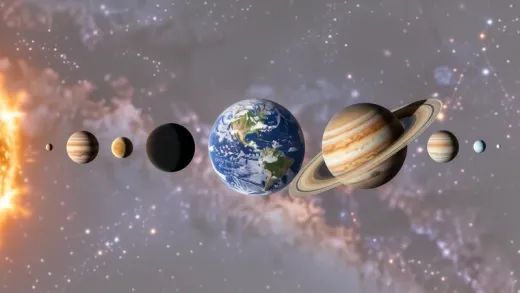
How many planets orbit the sun in second grade lessons
Learn how many planets orbit the sun and discover key facts about the eight official planets, from Mercury to Neptune, for students and educators.