Ways to calculate the zenith angle in astronomy
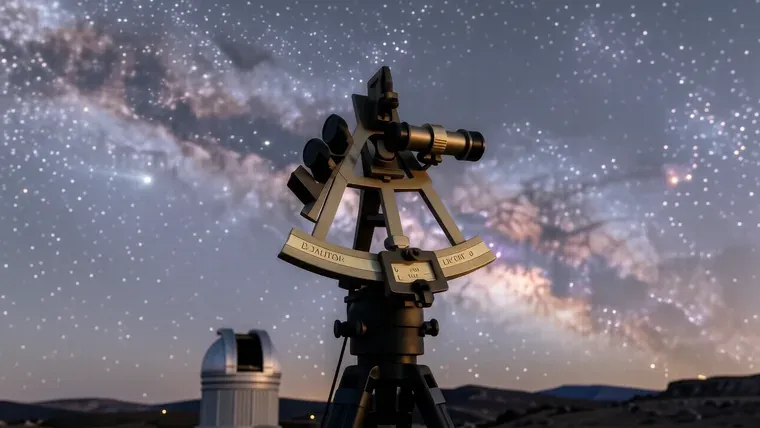
The zenith angle is the angular distance between a celestial object and the point directly overhead, known as the zenith. While many observers colloquially use “zenith” to describe the highest point an object reaches in the sky, astronomers define it specifically as the complement of the object’s altitude. If a star has an altitude of 40°, its zenith angle is exactly 50°.
Defining the Vertical Axis
The zenith points up. It is a mathematical abstraction. In geophysics and meteorology, this direction aligns with the vector opposite to the local gravitational force because gravity pulls objects toward the center of the Earth’s mass. This vertical line passes through the observer’s position and extends into space.
The nadir lies below. It is the exact opposite. While the zenith marks the highest point on the celestial sphere, the nadir points directly toward the Earth’s core so that it remains invisible to any terrestrial observer. These two points form a single diameter of the celestial sphere.
A plumb line helps. It defines the vertical. If you hang a weight from a string, the line it forms establishes the local vertical because the string aligns itself with the direction of gravity at that specific coordinate. This line intersects the horizon at a 90° angle.
The horizon is flat. Mostly. Although the Earth’s surface curves, we treat the mathematical horizon as a plane that passes through the observer’s position while remaining perpendicular to the local vertical. This intersection creates a great circle on the celestial sphere.
Calculating the Angle via Altitude
Altitude measures height. It is measured in degrees. The zenith angle ($z$) relates directly to the altitude ($h$) through the simple subtraction $z = 90^\circ - h$. You use this because knowing how far an object is from the horizon allows you to determine its distance from the vertical.
The math is easy. Use a protractor. If you observe a star at an altitude of 15°, you subtract that value from 90° so that you arrive at a zenith angle of 75°. This calculation remains consistent regardless of your location on Earth.
Shadows provide clues. They change length. On 21 June, the Sun reaches its highest point over the Tropic of Cancer, which means shadows in those latitudes reach their minimum length at solar noon. You can use a stick to find this moment because the shortest shadow indicates the Sun is closest to the zenith.
| Variable | Description | Unit |
|---|---|---|
| $h$ | Altitude (angle above horizon) | Degrees ($^\circ$) |
| $z$ | Zenith Angle | Degrees ($^\circ$) |
| $\phi$ | Observer’s Latitude | Degrees ($^\circ$) |
| $\delta$ | Declination of the object | Degrees ($^\circ$) |
Solar Geometry and Latitude
The Sun moves daily. It follows a path. The Sun’s declination ($\delta$) changes throughout the year because the Earth’s axis remains tilted at 23.4° relative to its orbital plane. This tilt causes the Sun to appear higher or lower in the sky depending on the season.
Latitude matters deeply. It defines your position. To find the Sun’s altitude at noon, you can use the formula $h = 90^\circ - \phi + \delta$ because this accounts for both your location and the current solar position. If your calculated $h$ exceeds 90°, the Sun is actually on the opposite side of the sky.
The tropics are key. They are narrow zones. The Sun passes through the zenith only between the Tropic of Cancer (23.5°N) and the Tropic of Capricorn (23.5°S) because these latitudes represent the limits of solar declination. Most people living in temperate zones never see the Sun at a true 0° zenith angle.
The equinoxes are balanced. Day equals night. On 21 March or 23 September, the Sun crosses the celestial equator so that its declination is exactly 0°. During these periods, the solar zenith is located directly above the Earth’s equator.
One can estimate position. Use the Sun. If you know the date and your altitude, you can work backward to find your latitude because the relationship between these variables is fixed by celestial mechanics. For example, on 12 April, a person in Makeyevka would calculate their solar position based on the days elapsed since the vernal equinox.
Coordinate Systems and Reference Frames
The horizontal system works. It uses the horizon. This system relies on azimuth and altitude to locate objects because it is tied directly to the observer’s local environment. It is useful for quick observations but fails to account for the Earth’s rotation over time.
Equatorial coordinates are better. They use RA and Dec. Right ascension ($\alpha$) and declination ($\delta$) provide a fixed grid on the celestial sphere so that astronomers can track stars even as the Earth rotates. This system remains independent of the observer’s specific latitude or longitude.
The ICRS is standard. It was adopted in 1997. The International Celestial Reference System provides a highly accurate framework for modern astrometry because it uses distant, non-moving objects like quasars as reference points. This system replaced older models to ensure precision across different telescopes.
Ecliptic coordinates exist. They follow the Sun. This system uses the plane of Earth’s orbit as its primary reference so that researchers can more easily study the movements of planets and asteroids within our solar system. The intersection of the ecliptic and the celestial equator defines the equinoxes.
The galactic system is different. It centers on the Milky Way. It uses the plane of our galaxy as a reference because many large-scale astronomical studies require a perspective that is not tied to the Sun or the Earth’s orbit.
Practical Observations and Errors
Refraction bends light. The atmosphere acts like a lens. As starlight enters the atmosphere, it bends toward the vertical so that celestial objects appear slightly higher in the sky than they actually are. This effect is most pronounced when an object is near the horizon.
Zenith telescopes are specialized. They point up. NASA’s Space Debris Observatory uses a liquid mirror telescope because the rotation of the liquid creates a perfect parabolic shape that can only be used to observe objects near the zenith. These instruments cannot tilt to look at the horizon.
Errors occur often. Check your math. If you use a manual protractor, small errors in alignment can lead to significant discrepancies in your zenith angle calculations because even a 1° mistake changes your perceived position. Digital sensors and automated mounts reduce this human error significantly.
The Sun is hot. It emits radiation. While observing the Sun at its zenith, one must use specialized filters so that the intense light does not cause permanent retinal damage. The photosphere emits the visible light we see, but the corona remains much hotter and extends far beyond the solar disk.
The sky changes color. This involves scattering. Sunlight scatters off molecules in the air, which creates the blue hue of the daytime sky while making the zenith appear darker through a polarizing filter. This phenomenon is most noticeable when the Sun is low on the horizon.
Mathematical Relationships in Spherical Astronomy
Spherical trigonometry is required. It handles the curves. To find the relationship between altitude, declination, and latitude, you must use complex formulas because the geometry of a sphere does not follow the rules of flat Euclidean planes.
The angle of incidence ($\omega$) matters. It affects solar energy. You can calculate this using $\omega = 90^\circ - \phi \pm \delta$ so that you determine how directly the Sun’s rays hit a specific point on the Earth’s surface. A smaller zenith angle results in a higher concentration of solar energy.
The meridian is central. It connects the poles. The celestial meridian is a great circle that passes through the observer’s zenith and the North and South celestial poles because it represents the line of longitude in the sky. When a body “culminates,” it is crossing this meridian at its highest possible altitude.
| Term | Definition |
|---|---|
| Azimuth | Angular distance along the horizon |
| Declination | Angular distance north or south of the equator |
| Right Ascension | Angular distance east of the vernal equinox |
| Hour Angle | Angular distance from the local meridian |
The Earth is an ellipsoid. It is not a sphere. Because the Earth rotates, it bulges at the equator, which means that geodetic measurements must account for this shape when calculating precise zenith angles for GPS or satellite tracking. The WGS 84 model provides the standard reference for these calculations.
Observers often confuse terms. Zenith and altitude are complements. If you find yourself struggling with the math, remember that the sum of an object’s altitude and its zenith angle must always equal exactly 90°. This simple check prevents many common errors in field astronomy.
Frequently asked questions
What is the formula to find the zenith angle from altitude?
The zenith angle (z) is calculated by subtracting the object's altitude (h) from 90 degrees, using the formula z = 90° - h.
How does latitude affect the Sun's position in the sky?
Latitude defines your position on Earth and determines solar altitude at noon via the formula h = 90° - φ + δ, where φ is latitude and δ is declination.
What is the difference between the zenith and the nadir?
The zenith is the point directly overhead in the sky, while the nadir is the exact opposite point located directly toward the Earth's core.
Why does atmospheric refraction affect zenith angle observations?
The atmosphere acts like a lens and bends starlight toward the vertical, making celestial objects appear slightly higher in the sky than their actual position.
More in Stargazing
The benefits of an apochromatic refractor
Learn how an apochromatic refractor uses ED glass and multiple lens elements to eliminate chromatic aberration for high-resolution astrophotography.
How to start choosing the perfect telescope for beginners
Learn how to select the right telescope by comparing refractors and reflectors, understanding aperture, and matching equipment to your observation goals.
Differentiating between refractor and reflector telescopes
Learn the key differences between refractor and reflector telescopes to choose the right optical design for planetary viewing or deep-sky observation.
A beginner's guide on how to use Stellarium
Learn how to use Stellarium to simulate the night sky, configure geographical coordinates, and optimize visual settings for celestial observation.