What is the duration of light travel from the sun to the earth?
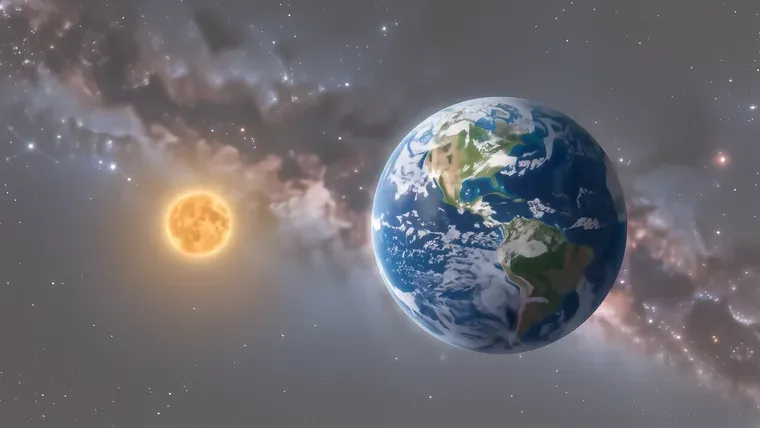
Light travels from the Sun to the Earth in approximately 8 minutes and 20 seconds on average. This duration fluctuates because the Earth follows an elliptical orbit rather than a perfect circle, which changes the distance between our planet and the Sun throughout the year. At perihelion in early January, light takes roughly 8 minutes and 3 seconds to reach us, while at aphelion in early July, the transit time increases to approximately 8 minutes and 25 seconds.
The physics of solar photons
The Sun is a massive sphere of plasma. It generates energy through thermonuclear fusion in its core. At the center of this star, temperatures reach 15 million Kelvin because the immense gravitational pressure forces hydrogen atoms to fuse into helium. This process converts 600 million tons of hydrogen into helium every single second.
Photons are created during these fusion events. They are weightless particles that move at a constant velocity in a vacuum. A photon does not exit the Sun immediately after its creation. It must navigate a dense environment of gas and plasma, so it undergoes millions of absorptions and re-emissions before reaching the photosphere. This journey from the core to the surface takes approximately 200,000 years.
The Sun’s surface temperature is much lower than its core. It measures roughly 5,726.85°C or 6,000 Kelvin. Once a photon escapes this outer layer, it enters the vacuum of space. In this vacuum, the speed of light remains constant at 299,792,458 meters per second, as established by the physics explored in Albert Einstein’s theory of relativity.
The energy released during fusion sustains all life on Earth. Without these constant photon emissions, our planet would freeze. Solar radiation is quite powerful. It can penetrate ocean waters to depths of 85 meters before being fully absorbed or scattered.
Orbital mechanics and transit variability
Earth does not maintain a fixed distance from the Sun. The orbit is an elongated ellipse. This geometry causes significant changes in light travel time.
- Perihelion (January): ~147 million km; light travel time is ~8 minutes 3 seconds.
- Aphelion (July): ~152 million km; light travel time is ~8 minutes 25 seconds.
- Mean distance (1 AU): ~149.6 million km; light travel time is ~8 minutes 17 seconds.
The Astronomical Unit (AU) serves as a standard reference for these distances. While 1 AU is often treated as a static number in basic textbooks, it is actually a mean value. Because the distance varies by about 5 million kilometers between our closest and farthest points from the Sun, the timing of sunlight arrival shifts accordingly.
If the Sun were to vanish instantly, we would not know for several minutes. The gravitational change would also propagate at the speed of light, meaning the physical effects of the Sun’s disappearance would arrive simultaneously with the loss of light. We are essentially seeing the Sun as it existed 8 minutes ago.
Measuring the cosmos with light
Astronomers cannot use kilometers to measure the gaps between stars. The numbers become too large for practical calculation. Instead, they use the light-year. A light-year is a unit of distance, not time. It represents the distance light travels in one Earth year, which is defined here as 365.25 days.
One light-year equals 9,460,730,472,580,800 meters. This is over 63,000 astronomical units. Using kilometers to describe the distance to a star like Proxima Centauri would be cumbersome. Instead, we say it is approximately 4.2465 light-years away.
Light travel times for various solar system objects include:
- The Moon: ~1.2 seconds.
- Pluto: ~5 hours.
- The Oort Cloud: ~1.5 years.
The delay in signal transmission affects space exploration. When the Soviet Union operated the Lunokhod rovers on the Moon, controllers had to account for the 1.2-second lag in radio wave propagation. This delay is a direct consequence of the finite speed of light.
The scale of the observable universe
The universe is expanding. This expansion affects how we perceive distance and time. When we look at distant galaxies, we are looking back in time. We see them as they were when the light first left them.
The Andromeda Galaxy is our closest large neighbor. It sits 2.52 million light-years away. This means the light reaching our telescopes today began its journey before humans existed. The star Polaris is roughly 400 to 600 light-years away, so its light was emitted around the time of Christopher Columbus’s voyages.
The observable universe has a radius of 13.77 billion light-years. However, because the cosmos is expanding while light travels, the objects that emitted that light are now much further away. Current estimates from NASA and other cosmological models place these objects at more than 46.5 billion light-years from Earth.
The diameter of the observable universe is approximately 93 billion light-years. This measurement is not a simple doubling of the radius because of the continuous expansion of space. The Metagalaxy grows larger every second.
| Object | Distance (Approximate) | Light Travel Time |
|---|---|---|
| Sirius | 8.6 light-years | 8.6 years |
| Milky Way Diameter | 100,000 light-years | 100,000 years |
| Andromeda Galaxy | 2.52 million light-years | 2.52 million years |
The scale of these distances makes traditional measurement tools useless. A single light-year covers about 10 trillion kilometers. Even the term “light-year” is a simplification for the immense voids found between galactic filaments.
Practical applications of light speed
Knowing the speed of light allows for precise navigation. Spacecraft trajectories depend on knowing exactly where a planet will be when a signal or a probe arrives. If we ignored the light-speed delay, our calculations for Mars landings would fail immediately.
The consistency of light in a vacuum is a fundamental constant. It does not change based on the observer’s movement or location. This allows scientists to use light as a cosmic ruler. By measuring the time it takes for a pulse to travel between two points, they can determine the distance with extreme accuracy.
We see this in the way we observe supernovae. When a star explodes in a distant galaxy, the delay between the event and our observation tells us exactly how far away that galaxy is. The light carries the data of the explosion across the vacuum.
The speed of light is 299,792,458 m/s. This value is exact. It is no longer measured but defined by the meter itself. Because the speed of light is a constant, the meter is defined as the distance light travels in 1/299,792,458 of a second.
Space remains vast and mostly empty. The time it takes for a photon to cross that emptiness defines our understanding of the history of the cosmos. We are always looking at the past when we look at the stars.
Frequently asked questions
How long does it take for sunlight to reach Earth?
On average, light takes approximately 8 minutes and 20 seconds to travel from the Sun to the Earth. This time varies between 8 minutes 3 seconds at perihelion and 8 minutes 25 seconds at aphelion.
How long does a photon spend inside the Sun before escaping?
A photon must navigate a dense environment of gas and plasma, undergoing millions of absorptions and re-emissions. This journey from the core to the photosphere takes approximately 200,000 years.
What is the difference between a light-year and an astronomical unit?
An astronomical unit (AU) is the mean distance between the Earth and the Sun, roughly 149.6 million km. A light-year is a unit of distance representing how far light travels in one Earth year, totaling about 9.46 trillion kilometers.
Why does the time sunlight takes to reach us change throughout the year?
The timing shifts because Earth follows an elliptical orbit rather than a perfect circle. This causes the distance to fluctuate between 147 million km in January and 152 million km in July.
More in Stars
How far away is the nearest star in light years?
Discover how far Proxima Centauri is from Earth and learn about its physical characteristics, planetary system, and distance measurements.
Methods used by scientists to calculate the distance to stars
Explore how astronomers use the cosmic distance ladder, from trigonometric parallax to standard candles and redshift, to measure stellar distances.
Reasons for the descent of stars from the heavens and their final
Learn why meteoroids appear as falling stars, how friction creates light during atmospheric entry, and where these cosmic fragments ultimately end up.
Shooting stars: An enigmatic phenomenon explained
Discover the science behind shooting stars, from the mechanics of atmospheric entry to the chemical composition of meteorites and predictable meteor showers.