What is the fifth largest planet in terms of size?
Uranus is the fifth largest planet in the solar system by diameter. It measures 50,724 kilometers across, which makes it significantly smaller than the gas giants Jupiter, Saturn, and Neptune, although it remains much larger than Earth.
The Hierarchy of Planetary Dimensions
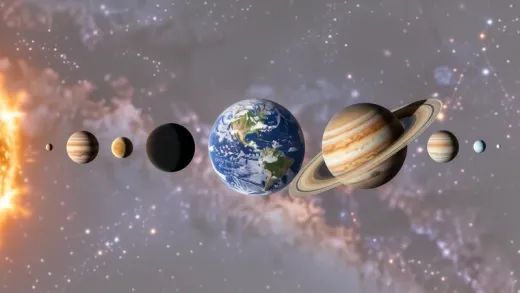
Size in the solar system depends on how an observer defines the metric. If we measure by mass, the order remains consistent with diameter, but the gaps between values shift. Jupiter is the largest. It possesses a mass 318 times that of Earth. Saturn follows as the second largest. Uranus occupies the third position in terms of diameter, while Neptune is the fourth.
The fifth largest planet is Uranus. It sits at a distance of 19.22 astronomical units from the Sun. This distance means it takes 84.01 Earth years to complete a single orbit. Because the planet orbits so slowly, its seasons last for decades.
The scale of these bodies is difficult to visualize. Jupiter has an average diameter of approximately 139,820 kilometers. If you placed Earth inside Jupiter, you would need 1,321.3 Earths to fill that volume. This massive scale ensures that Jupiter holds 2.5 times more mass than all other planets in the solar system combined.
The order of size from largest to smallest is:
- Jupiter (11.2 Earth diameters)
- Saturn (9.41 Earth diameters)
- Uranus (3.98 Earth diameters)
- Neptune (3.81 Earth diameters)
- Earth (1.0 Earth diameter)
The Composition of the Ice Giants
Uranus and Neptune are categorized as ice giants. This term distinguishes them from the gas giants, Jupiter and Saturn. While the gas giants consist mostly of hydrogen and helium, the ice giants contain higher proportions of “ices” such as water, ammonia, and methane. These substances exist in a hot, dense fluid state rather than as solid ice.
Uranus is the seventh planet from the Sun. It has a highly displaced axis. This tilt causes the planet to appear as if it is lying on its side during its orbit. The atmosphere consists of hydrogen, helium, and methane. Methane absorbs red light, which gives the planet its cyan color.
Neptune is the eighth planet. It was discovered in 1846 by Johann Gottfried Galle and Henry Louis d’Arré. Neptune is smaller than Uranus in diameter, but it is more massive. The mass of Neptune is 17.2 Earth masses compared to Uranus’s 14.6 Earth masses.
The internal structure of these planets remains a subject of intense study. Beneath the gaseous outer layers, there is a mantle made of ice. A solid rocky core exists at the center of both worlds. On 24 January 1986, the Voyager 2 spacecraft provided the first close-up views of Uranus, which changed our understanding of its ring system and moons.
Diamond Formation in Deep Mantles
Recent research suggests that the interiors of these planets might contain diamonds. Scientists have used high-powered optical lasers to replicate the extreme pressures found in planetary mantles. These experiments demonstrated that carbon transforms into crystalline diamond under such conditions.
The process is difficult to simulate. One physicist compared the difficulty of separating these elements back into their original states to making mayonnaise in reverse. This describes how the intense gravity and pressure force carbon atoms into specific lattice structures.
These diamonds do not stay suspended. They likely sink through the mantle toward the rocky core. Over thousands of years, these particles accumulate in thick layers. On Uranus and Neptune, the mass of these accumulated diamonds could reach a million carats.
Jupiter and Saturn may also host similar phenomena. In those gas giants, lightning strikes might trigger the conversion of methane into carbon. This carbon then descends through the atmosphere to form gemstones.
The following table compares the physical properties of the major planets:
| Planet | Diameter (Earth units) | Mass (Earth units) | Orbital Radius (AU) |
|---|---|---|---|
| Mercury | 0.382 | 0.055 | 0.38 |
| Venus | 0.949 | 0.815 | 0.72 |
| Earth | 1.000 | 1.000 | 1.00 |
| Mars | 0.530 | 0.107 | 1.52 |
| Jupiter | 11.200 | 318.000 | 5.20 |
| Saturn | 9.410 | 95.000 | 9.54 |
| Uranus | 3.980 | 14.600 | 19.22 |
| Neptune | 3.810 | 17.200 | 30.06 |
Orbital Mechanics and Discovery History
The history of planetary discovery is a mix of ancient observation and mathematical prediction. The planets Mercury, Venus, Earth, Mars, Jupiter, and Saturn were known to antiquity. These bodies move against the background of fixed stars.
Uranus was the first planet discovered with a telescope. William Herschel found it in 1781. He initially thought it was a comet because its movement appeared irregular. It took further observation to confirm its planetary nature.
Neptune followed a different path to discovery. Astronomers used mathematics to predict its location based on gravitational perturbations in the orbit of Uranus. This led Johann Gottfried Galle to find the planet in 1846.
Pluto is often discussed alongside these larger bodies. Clyde William Tombaugh discovered it in 1930. Although it was once called the ninth planet, it is now classified as a dwarf planet. The discovery of Eris, which has a diameter of 2,340 kilometers, contributed to the 2006 decision by the IAU to reclassify Pluto.
The solar system is part of the Milky Way galaxy. The Sun contains 99.86% of the total mass in our system. The four giant planets account for roughly 99% of the remaining mass. This concentration of matter dictates the gravitational stability of the entire region.
Comparative Planetary Characteristics
Comparing Earth to the giants reveals the vastness of space. Mars is often the primary point of comparison for terrestrial planets. Its diameter is 53% of Earth’s, which equals 6,739.8 kilometers. While Mars has a surface area similar to Earth’s landmass, its total mass is only 10.7% of our planet’s mass.
Uranus presents a different set of challenges. It possesses 27 known moons and a system of rings. These rings are composed of small particles. There are two inner rings and eleven outer rings. These structures likely formed from the debris of ancient satellite explosions.
Neptune also has a complex environment. It has 14 satellites, including Triton. Triton is an icy, barren world. Dust and nitrogen particles constantly escape from its surface. The winds on Neptune are among the fastest recorded in the solar system.
The density of these planets varies significantly. Earth has a density of 5,515 kg/m³. Jupiter has a much lower density of 1,326 kg/m³. This difference exists because Jupiter is composed mostly of light gases rather than rock and metal.
We cannot visit the cores of these giants. The pressure would crush any known probe. Even with future technology, we will likely never extract minerals from the depths of Uranus or Neptune. The thousands of kilometers of high-pressure fluid act as a barrier that remains impenetrable to human exploration.
The study of planetary size and composition continues through remote sensing. Instruments like those on the JWST provide data on atmospheric chemistry without needing to touch the surface. This allows us to map the distribution of methane and helium across the outer reaches of the system.
Frequently asked questions
Which planet is the fifth largest in the solar system?
Uranus is the fifth largest planet by diameter, measuring approximately 50,724 kilometers across.
What is the difference between gas giants and ice giants?
Gas giants like Jupiter and Saturn consist mostly of hydrogen and helium, while ice giants like Uranus and Neptune contain higher proportions of water, ammonia, and methane.
How does the mass of Neptune compare to Uranus?
Although Neptune is smaller in diameter, it is more massive, with a mass of 17.2 Earth masses compared to Uranus's 14.6 Earth masses.
Can diamonds form inside planets like Uranus and Neptune?
Yes, extreme pressure in the planetary mantles can transform carbon into crystalline diamonds, which may then sink toward the rocky core.
More in Solar System
Calculating the Earth's mass: A complex task
Learn how scientists use the gravitational constant and orbital mechanics to determine Earth's mass of approximately 5.9722 x 10^24 kg.
Discovering the current location of Voyager in interstellar space
Learn about the current location of Voyager 1 and 2, their distances from Earth, and how they navigate the harsh environment of interstellar space.
How many natural satellites does the earth possess?
Explore Earth's celestial companions, from the permanent Moon to transient quasi-satellites and cosmic dust clouds located at Lagrange points.
How many planets orbit the sun in second grade lessons
Learn how many planets orbit the sun and discover key facts about the eight official planets, from Mercury to Neptune, for students and educators.