What is the name of the sun's outermost layer of atmosphere?
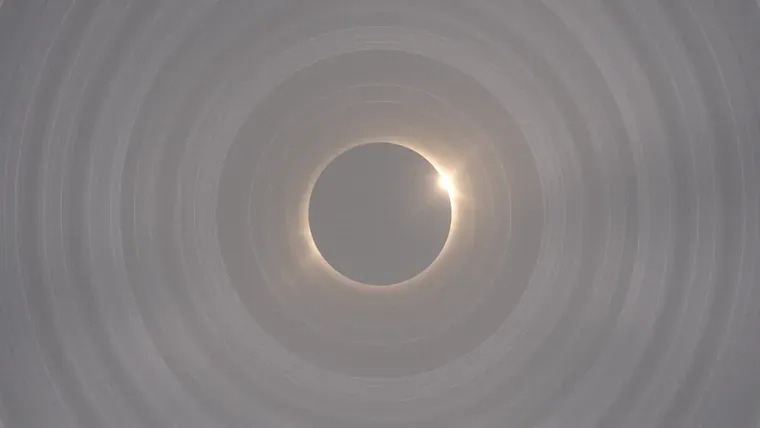
The solar corona is the outermost layer of the Sun’s atmosphere. It extends several solar radii into space and reaches temperatures exceeding 2,000,000 K. While the photosphere provides the visible light we see from Earth, the corona exists as a tenuous, high-temperature halo that remains invisible without a total solar eclipse or specialized coronagraphs. This layer transitions into the solar wind, which carries ionized plasma across the entire solar system.
The Photosphere and Granulation
The photosphere forms the base of the solar atmosphere. It measures between 100 and 400 kilometers in thickness. We see this layer as a bright disk because it emits the majority of the Sun’s visible radiation. Temperatures here range from 6,600 K at the upper edge to 4,400 K near the bottom.
It is bright. The surface appears textured due to convection cells called granules. These plasma bubbles have diameters between 700 and 1,000 kilometers. A single granule typically lasts only 5 to 10 minutes before it disappears. New granules emerge constantly because the convective zone beneath them continuously pushes hot matter toward the surface.
Sunspots appear here. They are dark regions where magnetic fields inhibit convection. These spots can reach diameters of 200,000 kilometers, which is larger than Earth. They remain cooler than their surroundings by approximately 2,000 to 2,500 K. This temperature difference makes them look dark against the brighter photosphere.
Magnetic fields drive this. On January 17, 2017, scientists used the Atacama Large Millimeter/submillimeter Array (ALMA) at the European Southern Observatory to peer inside a sunspot. They captured images at a wavelength of 1.25 mm so that they could map the magnetic structures more clearly. This observation provided a direct view of the plasma dynamics within these dark regions.
Sunspots follow cycles. The Schwabe cycle lasts approximately 11 years on average, although individual cycles vary between 7.5 and 16 years. After two such cycles, or 22 years, the Sun’s magnetic polarity returns to its original state. This longer period is called the Hale cycle after George Ellery Hale.
The Chromosphere and Spicules
The chromosphere sits above the photosphere. It acts as a middle layer with a thickness of roughly 10,000 to 15,000 kilometers. During a total solar eclipse, this layer appears as a reddish-pink band around the Moon’s silhouette. This color comes from the dominance of the H-alpha hydrogen emission line in its spectrum.
Temperatures rise here. Matter in the chromosphere warms from 4,000 K to 20,000 K as altitude increases. Despite this heat, the layer looks dim because the density of the plasma is extremely low. It is a thin veil.
Spicules dominate the structure. These are luminous plasma columns that extend across the solar surface. An average spicule lasts between 5 and 10 minutes. They can reach lengths of 20,000 kilometers as they shoot upward into the higher atmosphere.
The Italian astronomer Angelo Secchi observed these features in the late 19th century. He described the chromosphere as a “burning prairie” because the spicules looked like flickering flames across a field. This description captured the visual chaos of the plasma columns.
Magnetic loops shape the layer. Prominences appear as colossal arches of denser, cooler hydrogen gas. They rest upon the chromosphere and can last for several months if they remain stable. If the magnetic field becomes unstable, these structures transform into eruptive prominences that shoot matter into space at hundreds of kilometers per second.
The Corona and Solar Wind
The corona is the outermost layer. It is incredibly hot. Temperatures in this region reach 1 to 2 million K, which is much higher than the photosphere below it. This heating remains a subject of intense study because traditional models struggle to explain why temperature increases so sharply with distance from the core.
It is faint. We usually see the corona only during totality when the Moon blocks the photosphere’s glare. The corona consists of several components, including the K-corona and the F-corona. The K-component provides a continuous spectrum while the F-component becomes dominant at higher altitudes.
Solar wind originates here. This is a continuous stream of protons, electrons, and alpha particles. The extreme temperature of the corona prevents gravity from holding this matter near the Sun. Consequently, the plasma expands outward along magnetic field lines to occupy interplanetary space.
The wind moves fast. Near Earth, the solar wind travels at approximately 450 km/s. This speed increases as the particles move further away from the solar surface. The density is very low, often consisting of only a few particles per cubic centimeter.
Earth’s magnetosphere reacts. Our planet’s magnetic field creates a cavity in the shape of a teardrop to deflect this plasma. On the side facing the Sun, the magnetosphere is compressed by the wind’s pressure. On the night side, it extends into a long tail that may reach 6,000 times the Earth’s radius.
Solar Activity and Earthly Impact
Flares release immense energy. These are intense explosions in the chromosphere or corona near sunspots. A single flare can release $6 \times 10^{25}$ Joules of energy. This amount equals the electricity consumed globally for over a million years.
Space weather matters. Plasma clouds from flares reach Earth within two to three days. These arrivals trigger geomagnetic storms that disrupt satellite communications and power grids. They also create the aurora borealis in our polar regions.
The aurora glows. Charged particles collide with nitrogen and oxygen in our upper atmosphere. This process causes the gases to emit light. The colors depend on the specific altitude and the type of atom being struck.
We study this with satellites. NASA launched the STEREO spacecraft on October 26, 2006, to observe solar activity from multiple angles. Additionally, the Solar Dynamics Observatory was deployed on February 1, 2010. This mission provides high-resolution images across 12 different wavelengths so that we can monitor the Sun’s changing surface.
The Sun is old. It formed about 4.5 billion years ago from a collapsing molecular cloud. It remains stable because the core converts hydrogen into helium through thermonuclear fusion. This process provides the heat and light that sustains all life on Earth.
Solar Physics and Measurement
Luminosity defines solar power. This is the total energy emitted by the Sun in all directions per unit of time. We calculate this using the solar constant, which is the energy received by one square meter at Earth’s orbit. Current data places this constant at $1.4 \text{ kW/m}^2$.
The distance varies. The Sun sits approximately 149.6 million kilometers from Earth on average. Light takes about 8 minutes and 20 seconds to travel this distance. We see the Sun as a disk because of this proximity.
Temperature follows blackbody laws. Astronomers measure solar temperature by analyzing the spectrum of emitted radiation. The surface temperature sits at approximately 5,780 K. This value allows us to categorize the Sun as a G-type main-sequence star.
The core is dense. At the center, temperatures reach 15 million K. The density there is 150 grams per cubic centimeter, which is much higher than water. Energy moves from this core through the radiative zone via photon absorption and re-emission.
Radiation takes time. A single photon might take hundreds of thousands of years to escape the radiative zone. It bounces between atoms in a “random walk” before it finally reaches the convective zone. Once it hits the photosphere, it escapes into space at the speed of light.
Frequently asked questions
How hot is the Sun's outermost layer?
The solar corona reaches temperatures exceeding 2,000,000 K. This is significantly hotter than the photosphere, which ranges from 4,400 K to 6,600 K.
What are spicules in the solar atmosphere?
Spicules are luminous plasma columns found in the chromosphere that can reach lengths of 20,000 kilometers. They typically last between 5 and 10 minutes.
How long is the solar cycle?
The Schwabe cycle lasts approximately 11 years on average. A longer period called the Hale cycle takes about 22 years for the Sun's magnetic polarity to return to its original state.
What causes the aurora borealis on Earth?
The aurora is caused by charged particles from solar activity colliding with nitrogen and oxygen in Earth's upper atmosphere. These collisions cause the gases to emit light.
More in Solar System

Calculating the Earth's mass: A complex task
Learn how scientists use the gravitational constant and orbital mechanics to determine Earth's mass of approximately 5.9722 x 10^24 kg.
Discovering the current location of Voyager in interstellar space
Learn about the current location of Voyager 1 and 2, their distances from Earth, and how they navigate the harsh environment of interstellar space.
How many natural satellites does the earth possess?
Explore Earth's celestial companions, from the permanent Moon to transient quasi-satellites and cosmic dust clouds located at Lagrange points.
How many planets orbit the sun in second grade lessons
Learn how many planets orbit the sun and discover key facts about the eight official planets, from Mercury to Neptune, for students and educators.