How far can the Hubble telescope see?
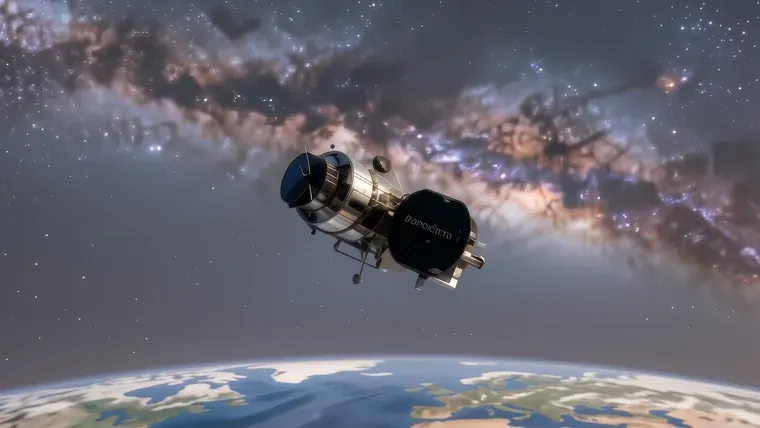
The Hubble Space Telescope captures light across the ultraviolet, visible, and near-infrared portions of the electromagnetic spectrum. Its primary mirror has a diameter of 2.4 meters. This aperture allows it to detect faint photons from distant galaxies that would otherwise remain invisible to ground-based observers. While its wavelength range is restricted compared to newer infrared-optimized observatories, Hubble provides the high-resolution visible light data necessary to study stellar populations and galactic structures.
The Deep Field Legacy
Robert Williams changed observational astronomy in 1995. He was the director of the Space Telescope Science Institute at that time. Most astronomers must submit rigorous proposals to use Hubble because the demand for observation time far exceeds the available hours. Williams, however, held the authority to allocate 10 percent of the telescope’s time to his own projects. He chose to point the instrument at a seemingly empty patch of sky in the constellation Ursa Major.
The target was tiny. It occupied an area roughly the size of a tennis ball when viewed from 100 meters away. This region, located near the handle of the Big Dipper, appeared devoid of stars or gas. Astronomers sought a “void” so that no foreground objects would interfere with the light coming from the most distant reaches of the universe.
The results were unexpected. From 18 December to 28 December 1995, Hubble collected 342 individual exposures. When these images were merged, they revealed more than 3,000 galaxies. These objects were not stars. They were massive collections of billions of suns located at varying distances from Earth.
The Hubble Deep Field provided a window into the early universe. Some of these galaxies existed shortly after the Big Bang. By analyzing the color and structure of these distant objects, researchers determined that the peak rate of star formation occurred approximately 8 to 10 billion years after the Big Bang. This finding helped establish a timeline for how the cosmos evolved from a chaotic state into the structured web of galaxies we see today.
- First Deep Field date: December 1995.
- Location: Ursa Major (Big Dipper).
- Galaxy count: Over 3,000.
Expanding the Search to the South
Cosmologists needed to verify if the Deep Field was a statistical anomaly. They had to ensure that the density of galaxies observed in Ursa Major was representative of the entire sky. To do this, they conducted the Hubble Deep Field South. This experiment targeted a region in the southern hemisphere as far from the original site as possible.
The data matched. The southern observations showed identical patterns of galaxy evolution and distribution. This confirmed the cosmological principle, which states that the universe is isotropic and homogeneous on large scales. It means the universe looks roughly the same in every direction. There are no special or “empty” zones that deviate from the cosmic average.
The telescope continued this work with increasing intensity. In the period between September 2003 and January 2004, Hubble targeted a field near the constellation Orion. This mission was much longer than the original 1995 attempt. The total exposure time spanned 11.3 days.
The Ultra Deep Field
The Orion observations produced the Hubble Ultra Deep Field. Astronomers combined 800 individual exposures to create this single, massive image. It captured more than 10,000 galaxies. This was a significant jump in data density compared to previous missions.
The light from the most distant galaxies in this field took 13 billion years to reach the telescope’s mirrors. These objects are among the earliest structures formed in the history of spacetime. The image revealed that early galaxies were not the elegant spirals we see in the local universe. Instead, they appeared smaller and more irregular.
These primordial galaxies functioned as compact star clusters. They lacked the organized arms seen in the Milky Way. This morphological shift indicates that galaxies grow and stabilize over billions of years through mergers and gas accretion.
Wavelength Limits and Physical Constraints
Hubble operates primarily in visible light. It can also see into the near-infrared spectrum between 0.8 and 2.5 micrometers. This range is narrow. Most of the infrared universe remains hidden from Hubble’s view because its instruments are not optimized for longer wavelengths.
The physics of the expanding universe creates a problem for visible-light telescopes. As space expands, the wavelength of light traveling through it stretches. This process is known as cosmological redshift. Light that began as ultraviolet or visible radiation in the distant past arrives at Earth as infrared radiation.
Because of this redshift, Hubble faces a “horizon” of visibility. It can see very far, but it cannot see the very first stars because their light has shifted too far into the infrared. To see those objects, a telescope must be designed to detect much longer wavelengths.
The limitations of Hubble are physical. The 2.4-meter mirror collects a specific amount of light. While this is sufficient for many tasks, it cannot compete with the collecting area of next-generation observatories. The sensitivity of a telescope depends heavily on its aperture and the wavelength it can detect.
- Visible range: ~0.4 to 0.7 micrometers.
- Near-infrared range: 0.8 to 2.5 micrometers.
- Primary mirror diameter: 2.4 meters.
The Transition to Infrared Astronomy
The James Webb Space Telescope (JWST) was designed to overcome the redshift barrier. While Hubble looks at what is visible, Webb looks at what has been stretched. JWST operates in the infrared spectrum from 0.6 to 28 micrometers. This allows it to see through cosmic dust that blocks Hubble’s view.
Dust clouds are opaque to visible light. They absorb ultraviolet and visible photons and re-emit them as heat. This thermal radiation falls into the infrared range. By observing in the infrared, Webb can peer into the hearts of star-forming regions and the centers of galaxies.
The scale of Webb is much larger than Hubble. Its primary mirror has a diameter of 6.5 meters. This provides a significantly larger collecting area for gathering faint photons. A larger mirror means higher sensitivity and better resolution for distant, redshifted objects.
Orbital Mechanics and Stability
Hubble orbits the Earth at an altitude of approximately 570 kilometers. This low Earth orbit allows for periodic servicing by the Space Shuttle or robotic missions. Webb is located much further away. It sits at the L2 Lagrangian point of the Earth-Sun system, which is 1.5 million kilometers from Earth.
The L2 position is stable. At this location, Webb can maintain a constant orientation relative to the Earth and the Sun. This is necessary because the telescope’s instruments must remain extremely cold to detect infrared light. A large solar shield protects the mirrors from the heat of the Sun, Earth, and Moon.
The Ariane V rocket was required for the launch. It provided the massive thrust needed to send a heavy observatory to the L2 point. Once there, Webb operates in a thermal environment that is vastly different from Hubble’s low Earth orbit.
The two telescopes work together. Hubble provides the ultraviolet and visible context for many deep-space observations. Webb provides the infrared depth. Together, they cover a much broader range of the electromagnetic spectrum than either could achieve alone.
Comparing Observational Capabilities
The difference in vision between these two instruments is stark. Hubble sees the “now” and the relatively recent past through visible light. Webb sees the “beginning” by capturing the stretched, infrared signatures of the first galaxies.
| Feature | Hubble Space Telescope | James Webb Space Telescope |
|---|---|---|
| Mirror Diameter | 2.4 meters | 6.5 meters |
| Primary Wavelengths | UV, Visible, Near-IR | Near-IR, Mid-IR |
| Orbit Location | Low Earth Orbit (570 km) | L2 Point (1.5 million km) |
| Infrared Range | 0.8 – 2.5 μm | 0.6 – 28 μm |
The infrared excess is a key indicator for astronomers. When a star is surrounded by a disk of dust, it emits more infrared radiation than expected. This signal suggests that planets might be forming within that disk. Hubble can detect some of these disks, but Webb’s sensitivity allows for much more detailed analysis of their composition.
The study of the galactic nucleus also requires infrared vision. Dust obscures the center of our own Milky Way. Visible light from the central black hole is blocked by this material. Infrared light passes through the dust relatively easily, allowing us to map the structure of the galactic core.
Hubble has provided the foundation for these studies. The Deep Field images proved that looking at “nothing” is actually a way to see everything. This philosophy continues as we move toward even larger and more sensitive instruments. The data collected by Hubble remains a primary reference for modern cosmologists.
Frequently asked questions
What wavelengths can the Hubble Space Telescope detect?
Hubble captures light across the ultraviolet, visible, and near-infrared portions of the spectrum, specifically covering a near-infrared range of 0.8 to 2.5 micrometers.
How large is the Hubble telescope's primary mirror?
The Hubble Space Telescope features a primary mirror with a diameter of 2.4 meters, which allows it to detect faint photons from distant galaxies.
Why can't Hubble see the very first stars in the universe?
Due to cosmological redshift, light from the earliest stars has been stretched into longer infrared wavelengths that fall outside Hubble's optimized detection range.
What was the significance of the Hubble Deep Field?
Conducted in December 1995, the Hubble Deep Field revealed more than 3,000 galaxies in a seemingly empty patch of sky, providing a window into the early universe.
More in Stargazing
The benefits of an apochromatic refractor
Learn how an apochromatic refractor uses ED glass and multiple lens elements to eliminate chromatic aberration for high-resolution astrophotography.
How to start choosing the perfect telescope for beginners
Learn how to select the right telescope by comparing refractors and reflectors, understanding aperture, and matching equipment to your observation goals.
Differentiating between refractor and reflector telescopes
Learn the key differences between refractor and reflector telescopes to choose the right optical design for planetary viewing or deep-sky observation.
A beginner's guide on how to use Stellarium
Learn how to use Stellarium to simulate the night sky, configure geographical coordinates, and optimize visual settings for celestial observation.