What is the shape of our galaxy in a nutshell?
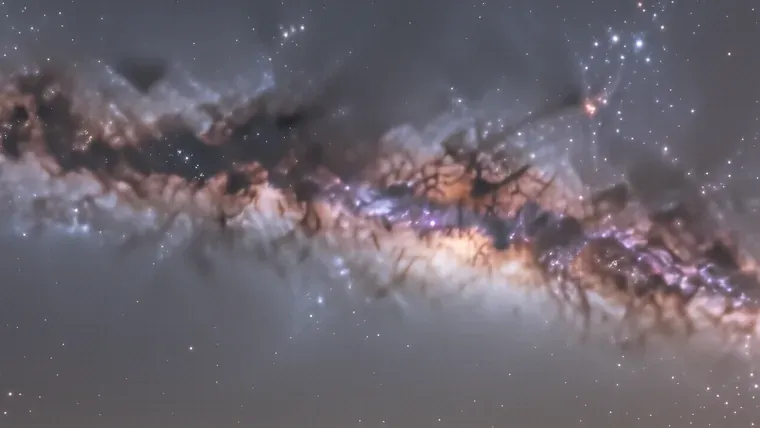
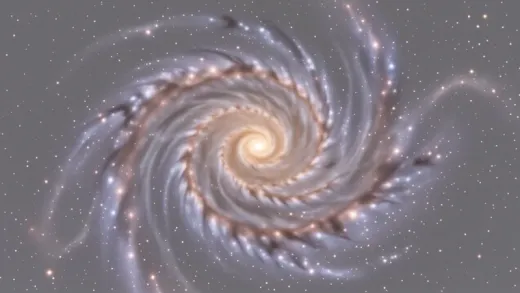
The Milky Way is a barred spiral galaxy. It consists of a central bulge, a flattened disk, and several spiral arms that extend outward into a massive spherical halo. While the visible luminous portion spans approximately 100,000 light-years in diameter, recent studies suggest the total gravitosphere may reach up to 1 million light-years because the gravitational influence of its mass extends far beyond the detectable starlight.
The Anatomy of a Spiral Disk
The galaxy has structure. It is not a uniform cloud. A central bulge contains a dense concentration of ancient stars that follow elongated paths, although much of this region remains obscured by thick layers of interstellar dust. This dust absorbs visible light. We see only a dark band in the night sky because these clouds block our direct view of the galactic center.
The disk is flat. It rotates constantly. Stars and gas clouds move in circular orbits within this plane, while the rotational speed changes depending on the distance from the central nucleus. At a distance of 2,000 light-years from the core, the rotation reaches 250 kilometers per hour. This movement is not uniform.
The spiral arms provide structure. They contain most of the galaxy’s young stars and gas. Five primary arms intersect constellations like Perseus, Orion, and Sagittarius, although their exact number remains a subject of debate among astronomers using radio telescopes. These arms form because large-scale waves of compression move through the interstellar gas.
The thickness varies. The disk is relatively thin. It measures approximately 1,000 light-years in thickness at most points, but it swells significantly near the central bulge where the diameter reaches 12,000 light-years. This shape resembles a stack of disks with a central sphere.
The Sun lives here. We are far from center. Our solar system occupies a position in the Orion arm roughly 26,000 to 28,000 light-years away from the galactic nucleus. This location provides stability. The Earth resides in a corotational orbit so that it avoids the high-radiation environments found deeper within the spiral arms.
The Galactic Core and the Central Engine
The center is bright. It sits in Sagittarius. A massive bulge of stars dominates this region, although infrared observations from telescopes reveal a more complex “peanut” shape hidden behind the dust. This structure contains roughly 20 million red giant stars.
A black hole resides there. It is supermassive. At the very heart of the Milky Way lies Sagittarius A*, a compact object with a mass equivalent to approximately 4 million suns. It exerts massive gravity. Stars in the immediate vicinity follow highly unusual, high-velocity trajectories because the gravitational pull of this singularity is so intense.
The core is hot. Temperatures are extreme. The central region emits non-thermal radiation with temperatures reaching 10,000,000 degrees Celsius, while the surrounding gas ring provides the raw materials for new star formation. This process is active. New stars emerge from these dense molecular clouds after gravity collapses the gas.
The Keystone structure exists. It is massive. Spanning 27,000 light-years, this central feature contains about 22 million red stars and a high concentration of molecular oxygen. It facilitates growth. Star formation occurs prolifically in this region because the density of gas remains high enough to trigger gravitational collapse.
Darkness hides the nucleus. Dust clouds are thick. We cannot see the ellipsoid-shaped nucleus with visible light, so astronomers must rely on long-wavelength radio waves and infrared data to map the interior. These observations bypass the dust. They allow us to see through the opaque layers of the interstellar medium.
The Halo and the Extended Gravitosphere
The halo is vast. It surrounds everything. A spherical corona of old, low-mass stars and globular clusters extends far beyond the visible disk, although its exact boundaries remain difficult to define. This region contains dwarf galaxies. Many small satellite galaxies orbit the Milky Way within this massive envelope.
The halo is old. It formed early. Most stars in the corona are over 12 billion years old, while the gas within it shows signs of being captured from smaller, swallowed galaxies. This suggests a violent history. The Milky Way grew by absorbing smaller neighbors through gravitational tidal forces.
Recent data changes our view. The size is larger. On June 27, 2024, a report presented at the University of Edinburgh suggested that the galaxy’s halo might extend to 1 million light-years in diameter because of the observed velocities of distant stars. This measurement is huge. It dwarfs the 100,000-light-year diameter of the luminous disk.
Mass is concentrated here. Dark matter dominates. Most of the galaxy’s mass does not emit light, so scientists infer its presence by observing how much gravity is required to keep stars in their high-speed orbits. This invisible matter makes up roughly 90% of the total galactic weight.
The gravitosphere expands. It reaches far out. The gravitational influence of the Milky Way may extend several million light-years into intergalactic space, so the galaxy is much larger than a simple collection of stars. This field dictates motion. It governs how nearby galaxies like the Magellanic Clouds interact with our own.
Stellar Populations and Galactic Motion
Stars vary greatly. They have different ages. Young stars appear blue and hot, while older stars in the halo tend to be red and cool, although both types contribute to the total mass. We see many colors. The spectrum of the night sky reflects this diverse stellar evolution.
The Sun is middle-aged. It orbits the center. It takes approximately 230 to 250 million years to complete one single revolution around the galactic nucleus, so the Sun has only circled the center about 25 times since its birth. This period is a galactic year. Our position remains relatively stable within the disk.
Clusters provide clues. They group together. Globular clusters are tightly packed spheres of ancient stars near the center, while scattered clusters contain younger stars that are still forming from gas clouds. These groups move together. They share a common origin in the early history of the galaxy.
Brown dwarfs are common. They are dim. The galaxy may contain as many as 100 billion brown dwarfs, although these objects are too cool to shine brightly in the visible spectrum. They represent the “tip of the iceberg” in terms of stellar mass. Most of these bodies remain undetected by current surveys.
Motion is complex. It is not orderly. Individual stars move in various orbits, while entire arms rotate at different speeds, creating a sense of chaotic movement throughout the galactic disk. This turbulence is normal. It results from the constant interaction between gas, dust, and gravity.
The Future of our Galactic Home
Collisions are coming. Gravity pulls neighbors. The Milky Way is currently moving toward the Andromeda galaxy, which is located 2.5 million light-years away, so a massive merger is inevitable in the distant future. This event will be huge. It will fundamentally change the shape of both galaxies.
Andromeda is larger. It has more stars. M31 contains at least 1 trillion stars, while the Milky Way holds between 200 and 400 billion stars. This difference ensures that the merger will result in a new, massive elliptical galaxy. The current spiral structure will disappear.
The Magellanic Clouds are close. They will merge soon. Models published in 2014 suggest the Large and Small Magellanic Clouds may be assimilated by the Milky Way within approximately 4 billion years. This process is gradual. It will add more gas and stars to our system over eons.
The Local Group evolves. We are not alone. The Milky Way, Andromeda, and the Triangulum galaxy form the core of the Local Group, although many smaller dwarf galaxies also belong to this collection. These groups eventually coalesce. They form larger structures like the Virgo Supergroup.
Stars will change. Supernovae occur often. When massive stars reach the end of their lives, they explode and scatter heavy elements into the interstellar medium, so the next generation of stars will have higher metal content. This cycle continues. It drives the chemical evolution of the entire galaxy.
Frequently asked questions
What type of galaxy is the Milky Way?
The Milky Way is a barred spiral galaxy consisting of a central bulge, a flattened disk, and several spiral arms extending into a spherical halo.
How large is the Milky Way galaxy?
While the visible luminous portion is about 100,000 light-years in diameter, the total gravitosphere may reach up to 1 million light-years.
What is located at the center of our galaxy?
At the heart of the Milky Way lies Sagittarius A*, a supermassive black hole with a mass equivalent to approximately 4 million suns.
How long does it take the Sun to orbit the galactic center?
The Sun takes approximately 230 to 250 million years to complete one single revolution around the galactic nucleus, a period known as a galactic year.
More in Galaxies
A comprehensive list of names for celestial objects
Explore how astronomers use astronymics and cosmonymics to name stars, planets, and galaxies according to strict IAU protocols.
Methods for measuring the distance to celestial bodies
Explore the cosmic distance ladder, from trigonometric parallax and radar ranging to standard candles like Cepheid variables and Type Ia supernovae.
Methods for measuring the mass of celestial bodies
Explore how astronomers use orbital mechanics, binary star systems, and spectral broadening to calculate the mass of planets, stars, and galaxies.
Exploring the science of cosmology and the universe
Discover how modern cosmology explains the Big Bang, dark energy, and the evolution of our universe from its 13.8 billion year history to its eventual fate.