Understanding planetary dimensions: What is the size of a planet?
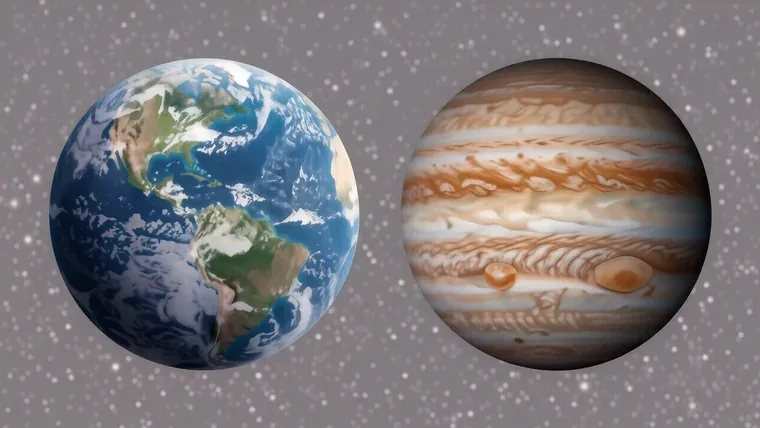
Planetary size in the solar system varies by orders of magnitude depending on whether a body is terrestrial or gaseous. Diameters range from Mercury at 4,879 km to Jupiter at 142,984 km. While many assume planets are perfect spheres, rapid rotation often causes equatorial bulging that creates an oblate spheroid shape.
The Terrestrial Planets
Mercury is small. It measures 4,879 km in diameter, which makes it smaller than both Ganymede (5,268 km) and Titan (5,152 km). Because the planet lacks significant rotational flattening, its shape remains almost perfectly spherical. This iron-rich world orbits the Sun at an average distance of 58 million km.
Venus follows Mercury. It has a diameter of 12,104 km. The rotation is slow. Although Venus shares a similar mass with Earth, it rotates on its axis once every 243.025 days so that its shape remains nearly spherical without significant polar flattening.
Earth is larger. Its equatorial diameter reaches 12,756 km. It is not perfectly round. Because the Earth rotates once every 23 hours, 58 minutes, and 4.1 seconds, the planet exhibits an equatorial bulge that makes the polar diameter 41 km smaller than the equator.
Mars is much smaller. The red planet has an equatorial diameter of 6,792.4 km. It is quite rocky. While the Martian day lasts 24 hours, 37 minutes, and 22 seconds, the planet maintains a polar flattening of 0.00589 which creates a 40 km difference between its poles and equator.
The terrestrial group includes:
- Mercury (4,879 km)
- Venus (12,104 km)
- Earth (12,756 km)
- Mars (6,792.4 km)
Gas Giants and Ice Giants
Jupiter dominates the system. It measures 142,984 km across its equator. It is massive. Because the planet rotates in only 9 hours and 55 minutes and 30 seconds, the equatorial diameter exceeds the polar diameter by 9,276 km.
Saturn is second. Its diameter reaches 120,536 km. It has rings. Although Saturn possesses a high flattening factor of 0.09796, its rotation period of approximately 10 hours and 33 minutes ensures the equatorial bulge remains significant.
The difference between Saturn’s polar diameter (108,728 km) and its equator is roughly 12,000 km. This makes it highly elliptical.
Uranus is an ice giant. It has a diameter of 50,724 km. It rotates oddly. While the planet completes one axial revolution in 17 hours, 14 minutes, and 24 seconds, its flattening index shows a difference of 1,172 km between its poles and equator.
Neptune is the last major planet. It measures 48,244 km in diameter. It is cold. Because Neptune completes a full axial revolution in 16 hours, 6 minutes, and 36 seconds, its equatorial diameter varies between 48,682 km and 49,528 km.
The giants follow this order:
- Jupiter (142,984 km)
- Saturn (120,536 km)
- Uranus (50,724 km)
- Neptune (48,244 km)
Defining Planetary Status
Size alone does not define a planet. The IAU established specific criteria in 2006 to categorize these bodies. A planet must orbit the Sun. It must also possess enough mass to achieve hydrostatic equilibrium, which forces the body into a nearly spherical shape.
Pluto failed one test. It orbits the Sun but has not cleared its orbital path of other objects. Because Pluto shares its orbital space with many Kuiper Belt objects, the IAU reclassified it as a dwarf planet in 2006.
The criteria are:
- Orbit around the Sun.
- Maintain a spherical shape via gravity.
- Clear the neighborhood around its orbit.
Measuring Scale and Distance
Distances vary wildly. Astronomers use the Astronomical Unit (AU) to simplify these gaps. One AU equals 150,000,000,000 km. This represents the average distance between Earth and the Sun.
The Sun is huge. It has a radius of 700,000 km. It occupies only 0.00001% of the volume of a sphere with a radius equal to Earth’s orbit. While the Sun contains most of the system’s mass, its physical size is small compared to the vast orbital distances.
Mercury stays close. Its distance from the Sun ranges from 46 million km to 70 million km. This means its position changes constantly throughout its 58,646-day sidereal period.
Venus sits further out. It stays roughly 108 million km from the Sun. Although it is often called Earth’s twin, the distance between the two planets can fluctuate significantly as they move through their respective elliptical orbits.
Earth stays at 1 AU. Mars sits approximately 300 million km away. Because the orbits are ellipses rather than perfect circles, the distance between any two planets is never a fixed number.
Physical Properties and Mass
Mass dictates gravity. Jupiter has a mass of 1.89 x 10^27 kg. It is enormous. While Earth’s diameter is roughly 12,700 km, Jupiter is over 315 times larger by volume in certain comparisons.
Saturn is less dense. Its mass is 5.66 x 10^26 kg. It has rings. Although Saturn is the second largest planet, its composition of gas and ice makes it much lighter than Jupiter relative to its size.
Uranus is heavy. It weighs 86.05 x 10^24 kg. It is blue. Because methane is abundant in its atmosphere, the planet reflects blue light while maintaining a diameter of 50,724 km.
Neptune is also massive. Its mass is 1.02 x 10^26 kg. It is distant. After the Voyager-2 mission passed the planet, scientists gained more precise data regarding its atmospheric composition and density.
The masses are:
- Jupiter: 1.89 x 10^27 kg
- Saturn: 5.66 x 10^26 kg
- Uranus: 86.05 x 10^24 kg
- Neptune: 1.02 x 10^26 kg
- Earth: 5.97 x 10^24 kg
Orbital Dynamics and Rotation
Rotation affects shape. Fast rotation causes bulging. Jupiter spins in under 10 hours. Because the angular velocity is so high, the planet cannot maintain a perfect sphere and instead forms an oblate spheroid.
Mercury rotates slowly. Its sidereal period is long. Although it orbits the Sun every 88 days, a single day on Mercury lasts 59 Earth days because of its specific rotational mechanics.
Venus rotates backward. It takes 243.025 days to spin once. This slow speed means that a day on Venus is longer than its year, which consists of only 225 days.
Mars has a familiar rhythm. Its day lasts 24 hours and 37 minutes. Because the Martian axial tilt is similar to Earth’s, the planet experiences seasons as it moves along its 687-day orbit.
The rotation periods are:
- Jupiter: ~9.9 hours
- Saturn: ~10.5 hours
- Uranus: ~17.2 hours
- Neptune: ~16.1 hours
- Earth: ~24 hours
Modeling the Solar System
Scaling is difficult. Most maps are wrong. To build a true scale model, one might use the Swedish Solar System approach. This model uses the 110-meter Ericsson globe in Stockholm to represent the Sun.
The scale is extreme. Jupiter appears as a 7.5-meter sphere. While the Sun is represented by a massive globe, the Earth would appear smaller than a flea if the distance to Neptune were stretched to only 100 meters.
Sedna is very far. It is represented by a 10-cm sphere in Luleå. Because this location is approximately 912 kilometers away from the Stockholm Sun, the model demonstrates how much empty space exists between celestial bodies.
The distances remain vast. Even with models, the scale of the Orion Arm remains hard to grasp. Our solar system sits 26,000 light-years from the Milky Way center.
Planetary diameters in kilometers:
- Mercury: 4,879
- Venus: 12,104
- Earth: 12,756
- Mars: 6,792.4
- Jupiter: 142,984
- Saturn: 120,536
- Uranus: 50,724
- Neptune: 48,244
The relationship between a planet’s rotation and its physical dimensions remains a primary factor in determining whether it appears as a sphere or an ellipsoid. These measurements allow astronomers to calculate gravitational pull and atmospheric pressure across the different worlds of our system.
Frequently asked questions
What are the largest and smallest planets in our solar system?
Jupiter is the largest planet with a diameter of 142,984 km, while Mercury is the smallest at 4,879 km.
Why are some planets not perfect spheres?
Rapid rotation causes equatorial bulging, creating an oblate spheroid shape. For example, Jupiter's equatorial diameter exceeds its polar diameter by 9,276 km.
What criteria define a planet according to the IAU?
A planet must orbit the Sun, maintain a spherical shape through hydrostatic equilibrium, and clear the neighborhood around its orbit.
How much larger is Jupiter than Earth?
Jupiter is significantly more massive and voluminous; it is over 315 times larger by volume in certain comparisons to Earth.
More in Solar System
Calculating the Earth's mass: A complex task
Learn how scientists use the gravitational constant and orbital mechanics to determine Earth's mass of approximately 5.9722 x 10^24 kg.
Discovering the current location of Voyager in interstellar space
Learn about the current location of Voyager 1 and 2, their distances from Earth, and how they navigate the harsh environment of interstellar space.
How many natural satellites does the earth possess?
Explore Earth's celestial companions, from the permanent Moon to transient quasi-satellites and cosmic dust clouds located at Lagrange points.
How many planets orbit the sun in second grade lessons
Learn how many planets orbit the sun and discover key facts about the eight official planets, from Mercury to Neptune, for students and educators.