What is the total number of stars in our galaxy?
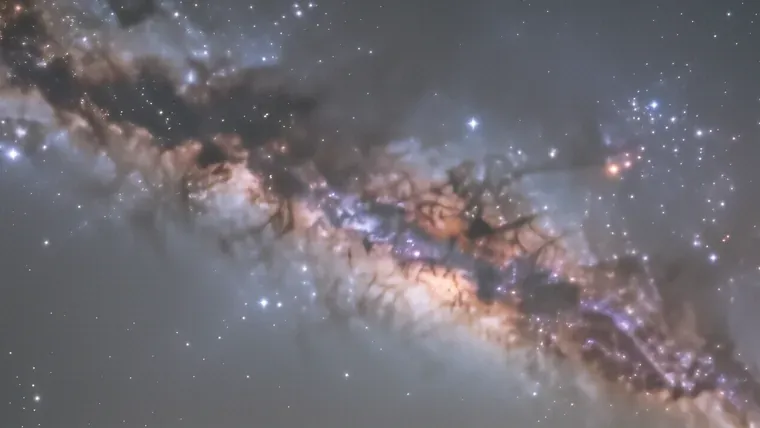
Astronomers estimate that the Milky Way contains between 200 billion and 400 billion stars. This range exists because we cannot count every individual stellar object through the dense clouds of interstellar dust that obscure our view from Earth. While some older models suggested a lower figure, modern infrared observations allow us to peer deeper into the galactic disk. The total number remains an estimate rather than a fixed value.
The difficulty of counting stars
Counting stars is hard. We rely on mathematical models and luminosity measurements because we cannot physically visit every corner of the spiral structure. Most of our observations occur from within the Orion arm, which is a relatively quiet branch located about 3,000 light-years from the Sun. This position limits our ability to see the central bulge clearly.
The view is obscured. Thick layers of gas and dust block visible light, although infrared telescopes like those used by NASA can penetrate these veils to reveal hidden stellar populations. We use the brightness of known objects to calculate the density of the surrounding regions. This method requires constant calibration.
Estimates vary widely. Some researchers suggest 200 billion stars while others argue for a population closer to 400 billion because the mass of the galaxy is difficult to partition between visible matter and dark matter. We must account for low-mass stars that emit very little light. These dim objects are often missed in standard surveys.
The math is complex. Astronomers use the total mass of the galaxy to work backward toward a stellar count, although much of that mass belongs to the non-luminous dark matter halo. If we ignore the dark matter, our calculations for the number of stars would be fundamentally flawed. We must balance these variables carefully.
Current data is evolving. The Gaia DR3 mission provides high-precision parallax measurements for billions of stars, so our understanding of galactic structure improves with every new data release from the European Space Agency. This precision helps us map the distribution of stars across the disk. It changes our perspective.
Galactic structure and composition
The Milky Way is a spiral galaxy. It features a central bulge and several prominent arms, including the Sagittarius, Perseus, Centaurus, and Swan arms. Most stars reside in the flat disk. This disk measures approximately 100,000 light-years in diameter.
The center is dense. Within the central 8,000 parsecs, the stellar density increases significantly because the gravitational pull of the galactic nucleus draws matter inward toward the core. Each cubic parsec near the center contains thousands of stars. This is much denser than our solar neighborhood.
A black hole sits at the heart. Sagittarius A* occupies the very center of the galaxy, and it is believed to be orbited by an intermediate-mass black hole. The combined gravity of these objects dictates the trajectories of nearby stars. They move in complex patterns.
The halo is vast. A spherical component called the galactic halo extends far beyond the visible disk, although it contains far fewer stars than the spiral arms. This region houses globular clusters and dwarf galaxies like the Large and Small Magellanic Clouds. It is a sparse environment.
We occupy a specific niche. The Sun orbits the galactic center at approximately 230 km/s, which means we complete one full revolution every 180 to 220 million years. This period is often called a galactic year. We are currently in the corotational circle.
- Diameter: ~100,000 light-years
- Disk thickness: ~1,000 light-years
- Bulge thickness: ~3,000 light-years
- Gas ring width: ~6,000 light-years
The role of dark matter
Dark matter is invisible. We cannot see it with telescopes because it does not emit, absorb, or reflect electromagnetic radiation. We only know it exists through its gravitational influence on visible stars and gas clouds. It is everywhere.
The mass is dominated by the unseen. While stars and gas make up a small fraction of the total mass, dark matter constitutes the majority of the Milky Way’s weight. Estimates place the total mass at roughly 3 × 10^12 solar masses. This includes the dark matter halo.
Gravity drives the rotation. Stars in the outer reaches of the galaxy move much faster than expected because the massive dark matter halo provides extra gravitational pull that keeps them in orbit. Without this hidden mass, the galaxy would fly apart. The rotation curves are clear evidence.
The detection is difficult. James Jeans and Jacobus Kapteyn first noted discrepancies in mass calculations in 1922, so astronomers have spent a century trying to define what this substance actually is. We still lack a definitive particle identification. It remains a mystery.
Dark matter affects light. Through gravitational lensing, the presence of dense dark matter can bend the path of light from distant galaxies, which creates distorted images known as cosmic mirages. This effect allows us to map its distribution. It acts like a lens.
Historical attempts at mapping
William Herschel began the work. In the 18th century, he attempted to count the stars in various parts of the sky to determine the shape of our stellar system. He believed the Milky Way was a flat, disk-like structure. His methods were primitive.
He found a pattern. By tallying stars in different directions, Herschel identified a concentration of light along the galactic equator, although he did not fully understand the three-dimensional nature of the disk. His observations provided the first real map. It was a major step.
The debate continued for decades. Vesto Melvin Slipher provided evidence that our galaxy was a single entity, while Immanuel Kant had previously suggested that other “nebulae” might be separate galaxies. This tension defined early 20th-century astronomy. The truth was elusive.
Edwin Hubble changed everything. In the 1920s, Hubble measured the distances to spiral nebulae and proved they were extragalactic, so the idea of a single, all-encompassing galaxy was finally debunked. This discovery expanded the known universe. It was a paradigm shift.
The scale is immense. We went from thinking we lived in the center of everything to realizing we are part of a massive system among billions of others. The perspective is humbling.
The future of the Milky Way
Collisions will happen. In approximately 4 billion years, the Milky Way will collide with the Andromeda Galaxy (M31). This event will merge the two systems into a single, larger elliptical galaxy. It will be violent.
The merger is inevitable. While the stars themselves are unlikely to collide because of the vast distances between them, the gravitational interaction will completely reshape the galactic structure. The gas clouds will compress. This will trigger massive star formation.
New names emerge. Some astronomers have proposed the name “Milkomeda” for the resulting super-galaxy, although this is a speculative term used to describe the eventual merger product. The current state is stable. We are safe for now.
Star formation slows down. The Milky Way uses up its hydrogen and helium over time, so the rate of new star creation will gradually decline as the gas reservoirs are exhausted. Eventually, the galaxy will become a quieter place. It will dim.
The Sun has a role. Our solar system will likely survive the encounter, although its position within the new galaxy will change significantly after the merger is complete. We will be part of something larger. The cycle continues.
Frequently asked questions
How many stars are in the Milky Way?
The Milky Way is estimated to contain between 200 billion and 400 billion stars. This range exists because interstellar dust obscures our view of many stellar objects.
Why is it difficult to count all the stars in our galaxy?
Counting is difficult because thick layers of gas and dust block visible light, and many low-mass stars emit very little light. Astronomers must use infrared observations and mathematical models to estimate populations.
What is the diameter of the Milky Way?
The Milky Way's flat disk measures approximately 100,000 light-years in diameter.
What will happen to the Milky Way in the future?
In about 4 billion years, the Milky Way is expected to collide and merge with the Andromeda Galaxy (M31), potentially forming a new elliptical galaxy often called Milkomeda.
More in Stars
How far away is the nearest star in light years?
Discover how far Proxima Centauri is from Earth and learn about its physical characteristics, planetary system, and distance measurements.

Methods used by scientists to calculate the distance to stars
Explore how astronomers use the cosmic distance ladder, from trigonometric parallax to standard candles and redshift, to measure stellar distances.
Reasons for the descent of stars from the heavens and their final
Learn why meteoroids appear as falling stars, how friction creates light during atmospheric entry, and where these cosmic fragments ultimately end up.
Shooting stars: An enigmatic phenomenon explained
Discover the science behind shooting stars, from the mechanics of atmospheric entry to the chemical composition of meteorites and predictable meteor showers.