What the view of our galaxy is like when observed from space
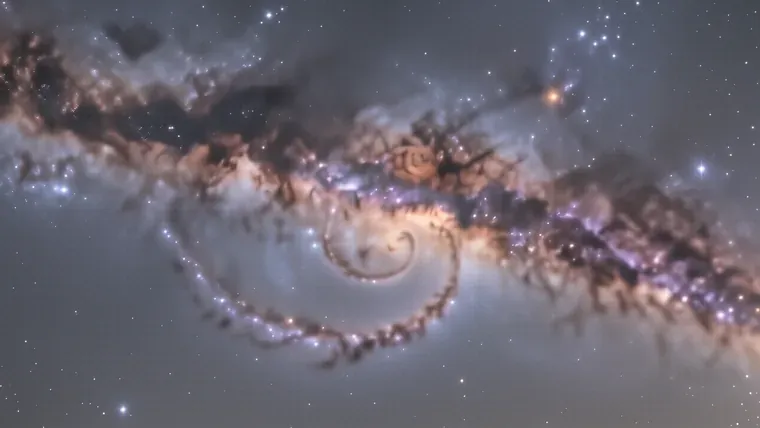
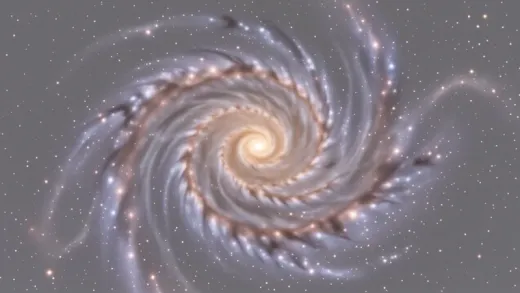
An observer located outside the Milky Way would see a massive, rotating spiral disk approximately 80,000 light-years in diameter and 1,000 light-years thick. This structure contains between 100 billion and 400 billion stars. While we view the galaxy from within the Orion arm, an external perspective reveals a central bar of aged red stars that stretches for roughly 27,000 light-years.
The Galactic Architecture
The Milky Way follows a spiral pattern. It is not a simple circle. Although many older models suggested a purely elliptical center, data from the Spitzer Space Telescope indicates a distinct, elongated central bar because the distribution of aged red stars follows a linear path across the core. This bar divides the inner spiral arms.
We reside in the suburbs. The Sun sits approximately 7.5 to 8.5 kiloparsecs from the center. We move quickly. Our solar system travels at a velocity of 220 to 240 km/s around the galactic nucleus, so it completes one full revolution roughly every 200 million years. This orbital period means the Sun has finished fewer than 30 revolutions since its formation.
The disk is thin. It measures about 1,000 light-years in thickness. While the disk holds most of the visible stars, a massive Galactic Halo encompasses the entire system. This halo extends 5,000 to 10,000 light-years beyond the visible edge. It contains hot gas and dark matter.
Dark matter dominates. It accounts for approximately 90% of the total galactic mass. We cannot see it directly. Astronomers infer its presence because the rapid rotation speeds of stars in the outer disk would otherwise cause the galaxy to fly apart under its own gravity.
The structure is complex.
- A central bar of red stars.
- Spiral arms containing gas and young stars.
- A thick and thin disk component.
- An extended spherical halo.
The Central Engine
The core is dense. It contains the Arca cluster. This region represents the most densely populated area of stars in our galaxy. Observations from the NASA SOFIA airborne observatory have provided new infrared views of this crowded environment because infrared light can penetrate the thick interstellar dust that blocks visible light.
Sagittarius A* sits at the center. It is a supermassive black hole. This object spans approximately 22.5 million kilometers in diameter. While the black hole itself emits no light, the surrounding gas and stars create a radiant glow that allows us to locate it.
The nucleus acts as a kitchen. It is a site of constant creation. Star formation continues actively within the core because the high density of gas provides the necessary raw material for gravitational collapse. This process produces white dwarfs, neutron stars, and massive clusters of glowing gas.
The center is small. It has a radius of about 1,000 parsecs. This area is compact compared to the rest of the galaxy. Although the nucleus is relatively small, the energy released by star formation and black hole activity dictates the evolution of the entire system.
Recent infrared data shows detail. The SOFIA telescope captured a 600-light-year span of the central region. This image includes a shimmering halo of silver light around the core. Scientists use this data to study how massive stars form near the supermassive black hole.
Galactic Dynamics and Evolution
Gravity drives everything. It pulls gas and stars into orbit. After pockets of hydrogen gas merge due to gravitational attraction, new stars begin to ignite through thermonuclear fusion. This cycle repeats as stars eventually die.
Stars die violently. Supernovae release heavy elements back into the interstellar medium. While these explosions destroy individual stars, they enrich the surrounding gas clouds so that future generations of stars contain more complex chemical compositions. This recycling sustains the galaxy over billions of years.
The Milky Way is aging. It is approximately 10 to 12 billion years old. Our solar system formed 4.57 billion years ago. We are a middle-aged system in a universe that continues to expand.
Galaxies collide. The Andromeda Galaxy approaches us at 120 kilometers per second. This collision will likely occur in about 4 billion years because the gravitational pull between our local group of galaxies is increasing. The Triangle Galaxy may also join this merger.
The Local Group contains many members.
- The Milky Way.
- The Andromeda Galaxy (M31).
- The Triangle Galaxy (M33).
- Approximately 50 smaller dwarf galaxies.
Observational Challenges
We are inside the disk. This makes external views impossible for human eyes. Interstellar gas and dust diminish the brightness of the central regions, so we must rely on specialized instruments to see through the obscuration.
Infrared is necessary. Visible light scatters easily. The Spitzer Space Telescope provided a comprehensive structural examination that allowed astronomers to confirm the existence of the elongated central bar. This tool changed our understanding of the galactic shape.
Ground-based viewing is limited. Light pollution hides the galaxy. Even in dark locations, we only see a fraction of the total stellar population because most stars are too dim or too obscured by dust for naked-eye observation.
Space telescopes provide clarity. The Hubble Space Telescope captures the details of supernova remnants. These images allow us to track the movement of gas as it is driven out of galaxies by intense radiation.
The view changes with technology. In 1610, Galileo Galilei used a telescope to see individual stars. In 1755, Immanuel Kant proposed that gravity holds these stars together. In the 1920s, Edwin Hubble proved that spiral nebulae were actually distant, independent galaxies.
The Dark Component and Mass
Mass is not just stars. Most of what we see is a minority. While stars provide the light, dark matter provides the structural integrity required to maintain the spiral shape during rotation. Without it, the outer edges would dissipate.
Rotation curves are key. Stars at the edge move as fast as stars near the center. This observation contradicts Newtonian physics unless a massive, invisible component exists because the visible mass is insufficient to provide the necessary centripetal force.
The total mass remains uncertain. Estimates vary across different studies. We know the ratio of dark matter to baryonic matter is high, but the exact particle nature of dark matter remains an unsolved problem in modern astrophysics.
We track it through gravity.
- Galaxy rotation speeds.
- Gravitational lensing of distant light.
- Cosmic microwave background fluctuations.
- Large-scale structure formation.
The Sun orbits the center. It takes 200 million years for one revolution. We have only completed about 30 revolutions since our birth. This slow movement means we inhabit a stable, relatively quiet part of the galactic disk.
Our position is fortunate. The Orion arm provides distance from the most violent star-forming regions. While the center is a crowded “kitchen” of radiation and high-density gas, our location allows for the long-term stability required for life to develop on Earth.
Frequently asked questions
What does the Milky Way look like from an external perspective?
An observer would see a massive, rotating spiral disk approximately 80,000 light-years in diameter with a distinct central bar of aged red stars.
How large is the supermassive black hole at the center of our galaxy?
Sagittarius A*, the supermassive black hole at the galactic center, spans approximately 22.5 million kilometers in diameter.
How long does it take for the Sun to orbit the galactic center?
The solar system travels at a velocity of 220 to 240 km/s, completing one full revolution around the nucleus roughly every 200 million years.
What role does dark matter play in our galaxy?
Dark matter accounts for approximately 90% of the total galactic mass and provides the gravitational force necessary to prevent the outer disk from flying apart.
More in Galaxies
A comprehensive list of names for celestial objects
Explore how astronomers use astronymics and cosmonymics to name stars, planets, and galaxies according to strict IAU protocols.
Methods for measuring the distance to celestial bodies
Explore the cosmic distance ladder, from trigonometric parallax and radar ranging to standard candles like Cepheid variables and Type Ia supernovae.
Methods for measuring the mass of celestial bodies
Explore how astronomers use orbital mechanics, binary star systems, and spectral broadening to calculate the mass of planets, stars, and galaxies.
Exploring the science of cosmology and the universe
Discover how modern cosmology explains the Big Bang, dark energy, and the evolution of our universe from its 13.8 billion year history to its eventual fate.