The stages of twilight as evening falls
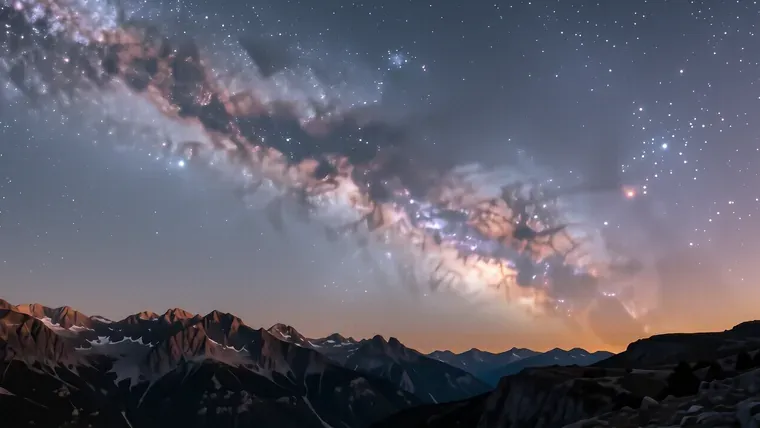
Twilight occurs when the Sun is below the horizon but its light still reaches the observer through atmospheric scattering. This phenomenon happens because Earth’s atmosphere deflects solar rays even after the Sun’s geometric center has physically descended past the horizon line. It follows a specific sequence of three stages: civil, navigational, and astronomical twilight. Each stage depends on the angular distance of the Sun from the horizon, measured in degrees.
The Three Stages of Twilight
Civil twilight is the brightest phase. It begins immediately after sunset or just before sunrise when the Sun’s center sits between 0° and 6° below the horizon. You can see clearly during this time. Most people can perform outdoor tasks such as reading without needing an artificial light source because the ambient illumination remains relatively high. In many jurisdictions, laws require vehicle headlights to be active during this period so that drivers maintain visibility on the road.
The horizon stays visible. It is quite bright. Only the most luminous planets and stars appear in the sky while the Sun is still within this 6° window. Venus often appears clearly without any optical aid if the atmospheric conditions are stable. This phase ends when the Sun reaches an angle of -6°.
Navigational twilight follows civil twilight. The Sun moves to a position between 6° and 12° below the horizon. Light fades quickly. The coastline or land outlines become difficult to distinguish because the scattering of light is no longer intense enough to illuminate terrestrial details. Sailors historically used this specific window to take measurements with a sextant so that they could determine their position using the visible stars.
Cities glow brightly here. Artificial lights dominate. This period offers a distinct opportunity for urban photography because the sky retains some color while the city lights provide high-contrast illumination. Astrophotographers often wait for the full Moon to sit just above the horizon during this stage. They capture dark silhouettes against the lunar disk.
Astronomical twilight is the final transition. The Sun sits between 12° and 18° below the horizon. Darkness approaches fast. The sky appears almost completely black to a casual observer, although the atmosphere still contains enough scattered light to prevent absolute darkness. This stage concludes when the Sun reaches -18°, which signals the onset of true astronomical night.
Stars become visible. Most planets appear. You can see the Milky Way during this time if you are in a location with low light pollution. However, deep-sky objects like distant nebulae or faint star clusters require the total darkness of night because the remaining solar scattering still interferes with sensitive observations.
Variations in Duration and Latitude
Location dictates the timing. The duration of twilight changes based on your latitude and the time of year. At the equator, twilight is brief. It lasts only about 20 to 24 minutes after sunset because the Sun’s path intersects the horizon at a nearly perpendicular angle. This rapid descent means the transition from day to night happens very quickly for equatorial observers.
The poles are different. Twilight lasts much longer. In high-latitude regions, such as those near the Arctic Circle, civil twilight can persist for several hours or even throughout the entire night. During the summer solstice in places like St. Petersburg, Russia, the phenomenon of “white nights” occurs because the Sun never sinks far enough below the horizon to reach true darkness.
The seasons matter too. Length varies by month. Twilight reaches its maximum duration during the summer and winter solstices on June 22 and December 22. Conversely, the shortest durations occur around the spring and autumn equinoxes on March 21 and September 23. This variation exists because the Earth’s axial tilt changes the angle at which solar rays strike the atmosphere throughout the year.
Latitude affects the speed of descent. High latitudes experience slower transitions. As you move toward the poles, the Sun’s disk follows a shallower path relative to the horizon so that it takes more time to pass through each degree of inclination. This results in extended periods of navigational and astronomical twilight for observers in places like Anchorage, Alaska, or Tromsø, Norway.
Light and Color Phenomena
The golden hour provides warmth. Photographers value this period near dawn and dusk. The light takes on a reddish hue because the Sun’s rays must travel through a much thicker layer of the atmosphere to reach your eyes. This scattering removes shorter blue wavelengths and leaves behind the longer red and orange wavelengths. Some sources, including PhotoPills, define this window as starting when the Sun is 6° above the horizon and ending when it reaches 4° below it.
Blue hour follows. It is often called the magic hour. The sky turns a deep, saturated blue after sunset. This happens because the remaining sunlight undergoes intense Rayleigh scattering, which prioritizes the shorter blue wavelengths while the red light has already dissipated. Many artists prefer this time for architectural photography because the cool tones create a calm atmosphere.
Colors fade in twilight. Perception changes rapidly. As the Sun sinks deeper, the ability to distinguish specific colors of terrestrial objects diminishes significantly. This is why field work becomes difficult during navigational twilight. You might see the shape of a tree, but you will struggle to identify its leaves’ color without a flashlight.
Darkness is not absolute. Light pollution interferes. In urban environments, artificial light from streetlamps and buildings creates a glow that obscures the natural transition of twilight. This “backlighting” makes it difficult to observe the stars because the scattered man-made light competes with the faint light from the cosmos.
Observing the Night Sky
Total darkness is necessary. This is an informal term for the period after evening astronomical twilight ends and before morning twilight begins. It occurs when the Moon does not illuminate the sky. Astronomers seek this specific window because it provides the highest contrast for observing faint celestial bodies like distant galaxies or star clusters.
Tools help with planning. You should use specialized software. Applications like Sky Tonight or the Ephemeris app provide precise timings for civil, navigational, and astronomical twilight based on your exact coordinates. These tools are essential for planning observations so that you do not waste time waiting for a darkness that has not yet arrived.
Light pollution is a problem. It hides the stars. Approximately one-third of the global population cannot see the Milky Way because of excessive artificial lighting. In the heart of a major city, the night sky can be ten times more illuminated than in rural areas. This glare effectively washes out the subtle light from the galaxy.
Travel to dark sites. Seek the shadows. If you want to see the Milky Way, you must move away from urban centers toward areas with low light pollution. Many observers use maps from the Photographer’s Ephemeris to find optimal locations for deep-sky photography. This planning ensures that you arrive at a site when the sky is truly dark.
Atmospheric and Planetary Differences
The atmosphere scatters light. It creates the glow. On Earth, this process is highly dependent on moisture and dust levels in the air. After a significant volcanic eruption, twilight can appear much longer or more intense because of the increased particulate matter in the upper atmosphere. These particles provide extra surfaces for sunlight to reflect and scatter.
Mars has different twilight. It lasts longer than on Earth. On the Red Planet, twilight can extend up to two hours before sunrise or after sunset. This occurs because the Martian atmosphere contains high concentrations of dust particles that scatter light differently than Earth’s nitrogen-oxygen mix. Observations from various Mars missions have confirmed these prolonged periods of dim illumination.
Refraction affects timing. The Sun appears higher. When calculating the exact moment of sunset, astronomers must account for atmospheric refraction and parallax. The geometric center of the Sun is often assumed to be at an altitude of -0°50′ when determining the onset of twilight. This correction ensures that the predicted times match the actual visual observations made on the ground.
The sky is dynamic. Conditions change constantly. Weather, cloud cover, and local topography all influence how much light reaches a specific observer during the transition from day to night. A thick layer of high clouds can extend the perceived brightness of civil twilight by reflecting more sunlight back toward the surface.
Frequently asked questions
What are the three stages of twilight?
The three stages are civil twilight (0° to 6° below the horizon), navigational twilight (6° to 12°), and astronomical twilight (12° to 18°).
How does latitude affect the duration of twilight?
At the equator, twilight is brief, lasting only about 20 to 24 minutes. In high-latitude regions near the poles, twilight can last for several hours or even persist throughout the night.
What is the difference between the golden hour and blue hour?
The golden hour occurs when the Sun is near the horizon, creating reddish hues through atmospheric scattering. The blue hour follows sunset, characterized by a deep blue sky caused by intense Rayleigh scattering.
Why is twilight longer on Mars than on Earth?
Twilight lasts longer on Mars, potentially up to two hours, because its atmosphere contains high concentrations of dust particles that scatter light differently than Earth's atmosphere.
More in Solar System
Calculating the Earth's mass: A complex task
Learn how scientists use the gravitational constant and orbital mechanics to determine Earth's mass of approximately 5.9722 x 10^24 kg.
Discovering the current location of Voyager in interstellar space
Learn about the current location of Voyager 1 and 2, their distances from Earth, and how they navigate the harsh environment of interstellar space.
How many natural satellites does the earth possess?
Explore Earth's celestial companions, from the permanent Moon to transient quasi-satellites and cosmic dust clouds located at Lagrange points.
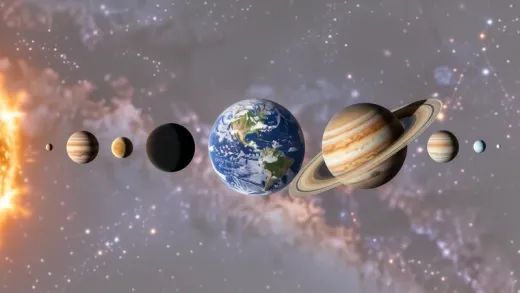
How many planets orbit the sun in second grade lessons
Learn how many planets orbit the sun and discover key facts about the eight official planets, from Mercury to Neptune, for students and educators.