Where to find the Milky Way in Russia
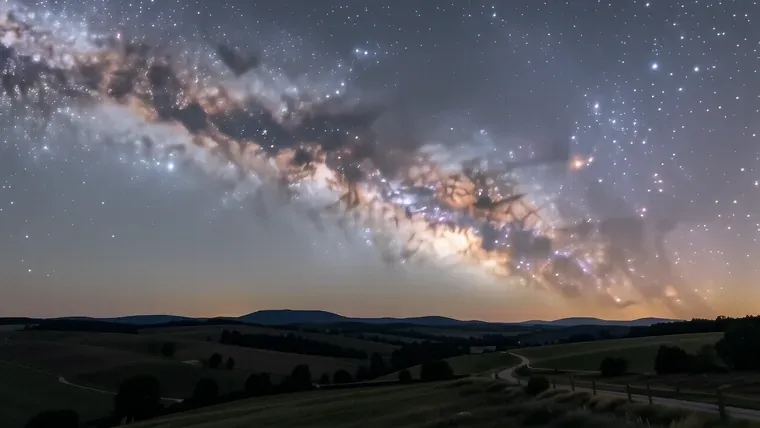
To find the Milky Way in Russia, you must travel at least 100 kilometers away from major urban centers to escape the effects of light pollution. The most effective locations for observing the galactic plane include the Arkhyz region in the Caucasus, the Chuyskaya Steppe in the Altai Republic, Lake Baikal, the Kola Peninsula, and the Vardane coastal area near Sochi. Observation is best during a new moon phase because even a partial lunar illumination can obscure the subtle nebulosity of the galactic disk.
The Observational Requirements for Dark Skies
Light pollution obscures the cosmos. It is a constant problem. While urban centers emit significant artificial radiance, remote wilderness areas provide the necessary darkness to resolve the structure of the Milky Way. You must seek out locations where the sky brightness is minimal so that the faint light from distant stars reaches your eyes without interference.
The Moon is a major obstacle. Even a crescent moon can act like a solitary automobile headlight if you are trying to observe dim nebulae. Most astronomers prefer the period surrounding the new moon because the absence of lunar light allows for the detection of objects with low surface brightness. If you plan a trip during a full moon, your primary target should be the Moon itself rather than the galactic center.
Atmospheric conditions also dictate success. Clear skies are mandatory for any meaningful observation.
- Avoid cities within 100 kilometers of your site.
- Check lunar phases using a synodic month calendar.
- Monitor local weather forecasts for cloud cover.
- Use a tripod for long-exposure photography.
Arkhyz and the Caucasus Observatory
Arkhyz offers exceptional darkness. It is very dark. This region contains the largest astrophysical observatory in Russia, which is situated at an elevation of 2,047 meters above sea level. The facility houses the BTA (Bolshoi Teleskop Azimutalnyi), a massive optical instrument that features a monolithic main mirror measuring 6 meters in diameter.
The sky here is remarkably clear. You can visit during the days surrounding a new moon to participate in organized stargazing sessions. These programs often include lectures on fundamental astronomy and allow observers to use binoculars or professional telescopes. The proximity to the Alanian Empire archaeological museum-reserve adds a historical dimension to the trip.
Travelers often find the altitude challenging. The air is thin. Because the observatory sits so high in the mountains, the atmospheric turbulence is often lower than at sea level, which improves the seeing conditions for astronomical observations.
The BTA telescope remains a centerpiece of Eurasian astronomy. It provides a window into deep space that few other terrestrial sites can match. Many amateur astronomers visit specifically to see how professional equipment operates under the same dark skies they are using for their own hobby.
The Altai Republic and the Chuyskaya Steppe
Altai is rugged. The landscape is vast. For those seeking the Milky Way, the Chuyskaya Steppe provides a massive 70-kilometer plain that is surrounded by mountain ranges and lacks electrical infrastructure. This absence of light makes the steppe an ideal location for observing constellations without the interference of streetlamps or residential glow.
Mount Belukha is the highest peak in Siberia. It is difficult to climb. While the summit offers a perspective of the cosmos that is hard to beat, most observers choose the steppe because the terrain is more accessible for setting up equipment. The Chuisky Tract serves as the primary artery for reaching this remote region.
Getting there requires planning. You can fly into Gorno-Altaisk and then rent a vehicle or take a bus. A bus journey along the tract takes approximately 7 hours and 40 minutes, although these services do not run every day.
- Flight to Gorno-Altaisk: starting at 11,600 rubles (round-trip).
- Bus fare: approximately 800 rubles (one-way).
- Best time for meteor showers: the Peresudy shower.
The steppe is silent. It is empty. After you set up your camp in the middle of this vast expanse, the sheer density of stars becomes apparent because there are no artificial light sources to compete with the natural luminosity of the sky.
Lake Baikal and Olkhon Island
Baikal is huge. It is deep. Despite the presence of tourists, the lack of major cities near the lake shores means that stargazing remains largely undisturbed. Most visitors rely on flashlights or smartphones, which prevents the creation of significant light domes that plague more populated regions.
Olkhon Island is a focal point for enthusiasts. Astronomy lectures are held regularly on the island to provide context for the celestial objects visible in the southern sky. The Irkutsk planetarium also organizes specialized observation routes for those who prefer guided tours.
Access depends on the season. In winter, you must travel 600 kilometers from Irkutsk to the ferry crossing by bus, which takes about 6 hours and costs approximately 1,700 rubles. During the summer, combined bus and ferry tickets make the journey more convenient for travelers.
A khivus provides transport to Olkhon. It takes 40-50 minutes. The cost is roughly 500 rubles per seat, though you must pay separate fees for transporting suitcases.
The water reflects the sky. It is a mirror. While standing on the shores of Lake Baikal, the horizon feels almost non-existent because the dark water blends into the dark atmosphere, creating an immersive sense of being surrounded by the cosmos.
The Kola Peninsula and Northern Lights
The north is cold. It is remote. On the Kola Peninsula, the summer months are dedicated to observing the Milky Way, while the period from September to April introduces the possibility of seeing the aurora borealis. Teriberka is a primary location for these sightings, provided you move far away from any settlement lights.
The northern lights appear frequently. They are unpredictable. While it is often suggested that the aurora can be seen approximately every three days, nature provides no absolute guarantees for any specific night. You must be prepared to wait for solar activity to interact with the Earth’s magnetic field.
Reaching Teriberka involves a flight to Murmansk. A direct round-trip flight starts at 6,600 rubles. From there, bus number 241 takes about 4 hours to reach the coast, and tickets cost approximately 600 rubles for a one-way trip.
- Primary summer target: The Milky Way.
- Primary winter target: Aurora Borealis and meteor showers.
- Recommended transport: Bus 241 from Murmansk.
The sky changes colors. It is beautiful. If you find yourself in Teriberka during a period of high geomagnetic activity, the sky may transform from black to green or violet as charged particles collide with atmospheric gases.
Coastal Observations in Vardane
Sochi is bright. It is loud. To see the stars near the Black Sea, you must avoid the main city and head to Vardane, located 30 kilometers southeast of Lazarevsky. This area offers a much darker sky than the metropolitan center because the coastal topography helps shield the area from urban light spill.
Vardane has amenities. It is convenient. You can find hotels and restaurants near the beach, which makes it an easier destination for those who want darkness without total isolation. The view of the Milky Way is often accompanied by the natural presence of fireflies in the local vegetation.
Travel to this area is straightforward. You can fly into Sochi for approximately 6,900 rubles for a direct round-trip. From the airport, the “Lastochka” train runs to Vardane in about 40-50 minutes, with tickets costing around 90 rubles for a single trip.
The sea is dark. It is calm. Because the horizon over the Black Sea is often unobstructed by mountains on one side, you can observe celestial objects as they rise from the water, providing a wide field of view for sweeping galactic structures.
Practical Tools for the Amateur Astronomer
Technology helps observers. It is useful. Applications like Star Walk 2 or Sky Portal allow you to identify constellations by pointing your smartphone at the sky. These tools are helpful for beginners who may struggle to distinguish Ursa Major from Ursa Minor in a dark environment.
Photography requires stability. It is difficult. If you intend to capture the Milky Way using a smartphone, you must use “Night Mode” to allow for extended exposure times. A tripod is indispensable because even a slight tremor during a several-second exposure will result in blurred stars.
The Andromeda Galaxy is visible. It is dim. Under truly dark skies, such as those found in the Altai or Arkhyz, you may be able to see the Andromeda Nebula (M31) without any optical aid at all. This galaxy is our nearest large neighbor and provides a sense of scale to the local group of galaxies.
- Identify stars: Use Star Walk 2.
- Capture images: Use a tripod and Night Mode.
- Navigate: Use a star map app.
The term “galaxy” relates to milk. The Greeks believed gods spilled milk across the sky. While this is a myth, the visual reality of the Milky Way’s dust lanes and star clusters provides a much more complex and scientific wonder than the ancient legends suggest.
Frequently asked questions
What is the best time of month to observe the Milky Way?
The best time for observation is during a new moon phase. This prevents lunar illumination from obscuring the subtle nebulosity of the galactic disk.
Where can I find professional telescopes in Russia?
The Arkhyz region in the Caucasus houses the BTA (Bolshoi Teleskop Azimutalnyi), which features a massive 6-meter diameter monolithic main mirror.
How far from cities should I travel to see the stars?
You should travel at least 100 kilometers away from major urban centers to escape the effects of light pollution and ensure minimal sky brightness.
What are the best locations for seeing the Northern Lights in Russia?
The Kola Peninsula, specifically near Teriberka, is a primary location for viewing the aurora borealis between September and April.
More in Galaxies
A comprehensive list of names for celestial objects
Explore how astronomers use astronymics and cosmonymics to name stars, planets, and galaxies according to strict IAU protocols.
Methods for measuring the distance to celestial bodies
Explore the cosmic distance ladder, from trigonometric parallax and radar ranging to standard candles like Cepheid variables and Type Ia supernovae.
Methods for measuring the mass of celestial bodies
Explore how astronomers use orbital mechanics, binary star systems, and spectral broadening to calculate the mass of planets, stars, and galaxies.
Exploring the science of cosmology and the universe
Discover how modern cosmology explains the Big Bang, dark energy, and the evolution of our universe from its 13.8 billion year history to its eventual fate.