Which planet is closest to Earth and why does it change?
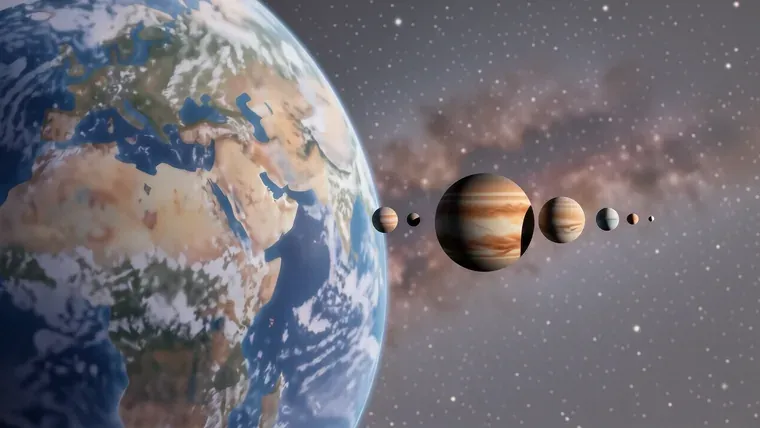
Venus is the closest planet to Earth in terms of orbital proximity. Although the planets constantly move through their respective paths, Venus reaches a minimum distance of 38 million kilometers from our world when the two bodies align. This distance varies significantly because orbital mechanics dictate that planets are rarely at their closest points simultaneously.
Orbital Dynamics and Proximity
The answer depends on timing. Space is never static. While Venus maintains the smallest average orbital gap, other planets can briefly become closer to Earth during specific celestial alignments. For instance, Mars reaches an opposition where it sits only 55 million kilometers away from us. This distance is actually smaller than the minimum distance Venus achieves during its closest approach.
Planetary motion is constant. We observe shifts daily. Because the planets follow elliptical paths rather than perfect circles, the gap between Earth and its neighbors fluctuates by hundreds of millions of kilometers throughout a synodic month or year. Mercury also enters this calculation when Venus moves to the far side of the Sun. During such periods, Mercury can sit as close as 82 million kilometers from Earth.
The math is complex. Distances change always. If you measure the distance between Earth and Venus at their maximum separation, you will find a gap of 261 million kilometers. This occurs after Venus has traveled to the opposite side of the solar system so that it remains hidden behind the solar disk from our perspective.
Venus is often called Earth’s sister. It is not. The planet has a diameter similar to ours, but its environment remains hostile. A thick atmosphere extends 350 kilometers above the surface, which exceeds the 100-kilometer threshold we define as the edge of space on Earth.
The Venusian Environment
Venus is hellish. It is hot. The atmosphere consists of 96% carbon dioxide and a heavy layer of sulfuric acid clouds. These clouds create a dense fog that prevents sunlight from reaching the surface for approximately 50 kilometers because the chemical composition scatters the incoming radiation so effectively.
Pressure is extreme. Heat is constant. Surface temperatures reach 467 degrees Celsius, which creates a runaway greenhouse effect that traps thermal energy near the ground. Atmospheric pressure at the surface exceeds Earth’s pressure by 90 times, so any unshielded probe would be crushed almost instantly upon arrival.
Acid rain falls. It evaporates. Although sulfuric acid precipitates from the upper cloud layers, the intense heat causes the droplets to evaporate before they can ever touch the rocky terrain. This cycle maintains a permanent shroud over the planet’s surface.
Exploration is difficult. Probes often fail. The Soviet Venera-13 mission successfully landed on the surface in 1981, but it could only operate for 127 minutes because the crushing pressure and heat quickly overwhelmed its electronic systems. It managed to transmit several photographs before the hardware succumbed to the environment.
Current methods differ. We use radio. Because visible light cannot penetrate the thick cloud deck, astronomers rely on radio telescopes and radar scanning to map the topography of the solidified magma and volcanic plains below.
- Venera-13 landing date: 1981.
- Minimum Venus-Earth distance: 38 million km.
- Venusian atmospheric CO2 concentration: 96%.
Stellar Neighbors and Parallax
Stars are far. They look bright. We see many stars in the night sky, but most are actually distant blue giants that appear luminous only because of their inherent energy output. Our nearest neighbor is the Sun, which sits approximately 150 million kilometers away.
Measuring distance requires math. We use parallax. By observing a star from two different points in Earth’s orbit, scientists calculate the angle of displacement so that they can determine how far the object resides from our solar system. This method works for stars within 100 light-years.
The RECONS collaboration tracks these distances. They study many systems. Since the mission began, the number of known star systems within 10 parsecs has grown from 191 to 316 because new surveys identify dim objects that previous telescopes missed. Most of these are red dwarfs.
Proxima Centauri is close. It is a dwarf. While Alpha Centauri A and B are famous, the third member of that triple system, Proxima Centauri, sits at a distance of 4.24 light-years. This makes it the closest individual star to our solar system.
The stellar population varies. Red dwarfs dominate. Among the 316 systems within 10 parsecs, 222 are M-class red dwarfs, which means they make up 66.5% of the local stellar neighborhood. Most stars are too dim to see without help.
- Proxima Centauri distance: 4.24 light-years.
- RECONS known systems (10pc): 316.
- M-class star percentage: 66.5%.
The Scale of the Cosmos
Space is mostly empty. Light travels slow. Even though Alpha Centauri is our neighbor, it would take the New Horizons spacecraft approximately 78,000 years to reach that system because of its current velocity and the vast distance involved. We are quite isolated.
Bright stars lie far. They deceive us. Sirius appears as the brightest star in the night sky, yet it sits 8.6 light-years away and is twice the mass of our Sun. Many people mistake brightness for proximity.
We lack local extremes. No black holes exist nearby. Within the 10 parsec radius, there are no neutron stars or black holes, although the neutron star 1RXS J141256.0 + 792204 exists 617 light-years away. You must travel much further to find such dense objects.
The Sun is aging. It will change. In about 1 billion years, the Sun will shine 10% brighter, which will likely trigger a greenhouse effect so intense that it prevents carbon-based life from surviving on Earth. The star is middle-aged.
Exoplanets are being found. We see them. Out of the 400 stars in our immediate vicinity, only 26 have confirmed planetary systems, including the TRAPPIST-1 system which sits 40 light-years away. Gliese 892 currently holds a record with six confirmed planets.
The Sun is G-class. It is yellow. While most stars are M-class, our Sun is a G-class star that has been burning for approximately 5 billion years. It contains 74% hydrogen and will eventually expand into a red giant.
Summary of Proximity
Planets move constantly. Distances shift often. Venus is the closest planet in terms of orbital path, but Mars or Mercury can be closer during specific windows of time. The geometry of the solar system ensures that “closest” is a moving target.
Stars are different. They emit light. The Sun is our nearest star, while Proxima Centauri remains the closest star outside our solar system at 4.24 light-years. We live in a crowded but mostly dark neighborhood.
The sky changes. We look up. Astronomers continue to use parallax and radio waves to refine these measurements so that we can better understand the true scale of our cosmic surroundings. The data continues to grow as new missions launch.
Frequently asked questions
What is the minimum distance between Venus and Earth?
Venus reaches a minimum distance of 38 million kilometers from Earth when the two bodies align.
How hot is the surface of Venus?
Surface temperatures on Venus reach 467 degrees Celsius due to a runaway greenhouse effect.
What is the closest star to our solar system?
Proxima Centauri is the closest individual star to our solar system, located at a distance of 4.24 light-years.
How much carbon dioxide is in the atmosphere of Venus?
The atmosphere of Venus consists of 96% carbon dioxide.
More in Solar System
Calculating the Earth's mass: A complex task
Learn how scientists use the gravitational constant and orbital mechanics to determine Earth's mass of approximately 5.9722 x 10^24 kg.
Discovering the current location of Voyager in interstellar space
Learn about the current location of Voyager 1 and 2, their distances from Earth, and how they navigate the harsh environment of interstellar space.
How many natural satellites does the earth possess?
Explore Earth's celestial companions, from the permanent Moon to transient quasi-satellites and cosmic dust clouds located at Lagrange points.
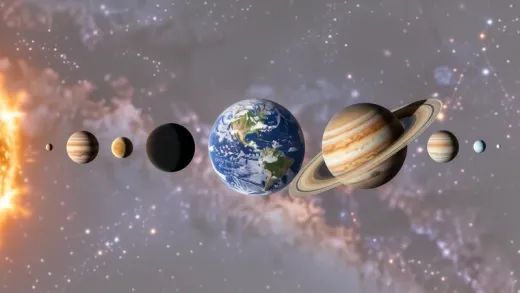
How many planets orbit the sun in second grade lessons
Learn how many planets orbit the sun and discover key facts about the eight official planets, from Mercury to Neptune, for students and educators.