The complex movement of the Sun
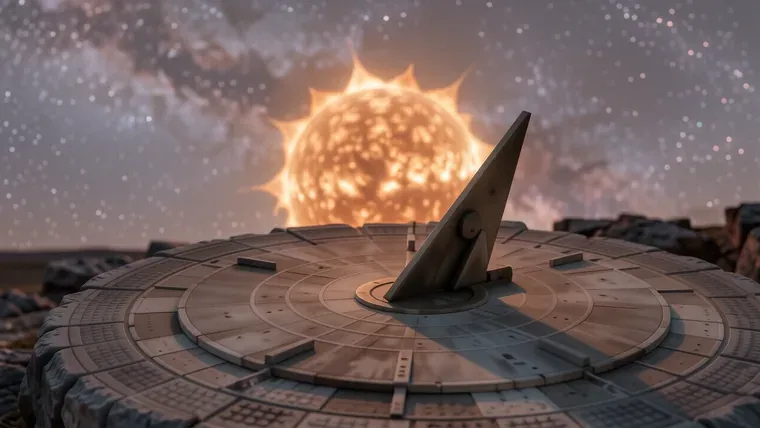
The Sun orbits the Galactic Center of the Milky Way at a velocity between 220 and 240 kilometers per second. It follows an elliptical path within the Orion Arm, completing one full revolution approximately every 225 to 250 million years. While the Earth revolves around the Sun, the entire solar system moves through space because the massive gravitational pull of the galactic core compels all local bodies into a collective orbital dance.
Galactic Motion and Orbital Dynamics
The Milky Way spans roughly 30,000 parsecs in diameter. One parsec equals 3.26 light-years. Our star sits approximately 26,000 light-years from the center. This central region contains a nucleus with a radius of about 1,000 parsecs. It is vast. Although the Sun follows a predictable path, the exact mechanism of its movement remains a subject of ongoing study because scientists are still determining how dark matter influences galactic rotation speeds.
The solar system moves. It does not sit still. We travel through the Local Interstellar Cloud while moving toward the constellation Hercules at a speed of roughly 20 km/s relative to nearby stars. This motion is distinct from our galactic orbital velocity. The Sun’s path through the galaxy is an endless loop.
The Sun crosses the galactic plane periodically. This cycle occurs every 30 to 35 million years. We move north and south. After the Sun completes a transit of the galactic plane, it begins its journey into the opposite hemisphere. This movement helps define our position within the spiral structure of the Milky Way.
The velocity changes. Data from NASA IBEX shows that the solar system possesses a tail. This structure forms as the solar wind interacts with the interstellar medium. It is a cosmic wake. While we move through the Local Bubble, this interaction creates a boundary that protects the planets from high-energy galactic radiation.
The Three Planes of Solar Motion
The Sun rotates on its axis. This is the second plane of motion. Because the Sun is composed of gaseous plasma rather than solid rock, it undergoes differential rotation. The equator spins faster than the poles. It is uneven. A sunspot near the solar equator takes 24.47 days to complete one revolution, while regions near the poles require approximately 38 days to finish a single turn.
Three planes exist. The first is the galactic orbit. The second is the axial rotation. The third involves the gravitational balanced center. This third plane exists because all the planets in our solar system exert a slight gravitational pull on the Sun. This collective tugging causes the Sun’s axis to trace a radius around a central balance point.
The Sun wobbles. It traces a complex path. While the Sun revolves around the galactic core, it also rotates around this specific gravitational center so that its movement remains stable within the local system. Astronomers track these subtle shifts using precise measurements.
Rotation is constant. The equator moves at 7,284 km/h. This speed is four times faster than Earth’s rotation. We see sunspots move. They provide the only reliable way to measure these varying rotational periods across different latitudes.
The Ecliptic and Celestial Geometry
The ecliptic is a vital concept. It defines the apparent path of the Sun across the celestial sphere. This path results from the Earth’s orbit around the Sun. It is a plane. Although we see the Sun move daily, this apparent motion is actually caused by the Earth’s own rotation and its yearly journey through space.
Most objects stay near it. The planets follow this line closely. Mercury shows the largest deviation at 7°. Other planets stay within 0.8° to 3.2° of the ecliptic plane. They are aligned. Because most solar system bodies occupy this narrow band, we often witness planetary conjunctions when two or more planets appear in close proximity.
The Moon also visits. It crosses the ecliptic frequently. Sometimes a moon-planet conjunction occurs. These events happen when the Moon passes within a few degrees of a planet in the sky. They are rare. On certain occasions, the Moon can even occult a planet, which means it completely covers the planet from an observer’s perspective.
The zodiac follows this path. Constellations like Aries and Pisces lie along the ecliptic. The Sun enters these regions annually. In 2000 years, the position of the equinoxes shifted because the Earth’s axis undergoes precession. This oscillation completes one full circle every 25,800 years.
The celestial equator differs. It is the intersection of Earth’s geographic equator with the celestial sphere. The ecliptic and equator meet at two points. These are the equinoxes. During the vernal equinox on March 21, the Sun’s declination is exactly 0°.
The solstices occur next. They happen 90° from the equinoxes. June 22 marks the summer solstice in the northern hemisphere. The Sun reaches its highest point here. While the seasons change, these points represent the extremes of the Sun’s apparent declination relative to the Earth’s equator.
Internal Structure and Energy Production
The Sun is massive. It contains 99.87% of the solar system’s mass. Its diameter is 1,392,000 km. This is 109 times larger than Earth. Heat comes from the core. Within this central region, temperatures reach 15,700,000°C so that hydrogen atoms can fuse into helium through the proton-proton cycle.
The core drives everything. It has a radius of 150,000 km. Pressure is immense. The density there is 150 g/cc, which is 7.5 times greater than gold. Energy moves outward. After the fusion occurs in the core, the energy travels through the convective zone where heated gases rise and cool gases descend.
The atmosphere has layers. The photosphere is the visible surface. Above it lies the chromosphere. This layer is about 2,000 km thick. It shows a red hue during solar eclipses. While the chromosphere is relatively thin, its temperature rises as altitude increases, reaching up to 20,000°C at its upper boundary.
The corona is outermost. It is very hot. Temperatures here soar to millions of degrees. We can only see it clearly during a total solar eclipse. Because the heating mechanism for the corona remains a mystery, scientists continue to study solar wind and magnetic reconnection to explain these extreme temperatures.
Magnetic fields fluctuate. The Schwabe cycle lasts 11 years. Sunspots appear during high activity. These spots are focal points for magnetic fields that project outward from the interior. Every 22 years, the magnetic polarity completes a full Hale cycle so that the field returns to its original state.
Stellar Evolution and the Future
The Sun is middle-aged. It is roughly 4.5 billion years old. It formed from a collapsing cloud of gas and dust. This process was slow. While the Sun currently provides stable energy, its composition changes as hydrogen is converted into helium through continuous thermonuclear reactions.
The Sun will expand. Hydrogen levels are dropping. In about 6.4 billion years, the core will deplete its primary fuel. The star will then grow larger. As the radius increases to 1.59 times its current size, the outer layers will eventually reach the orbit of the Earth.
A red giant follows. This phase lasts 10 million years. The Sun will become much brighter. Although this expansion will engulf the inner planets, the star will also lose about 28% of its total mass during this period. The loss of mass will cause surviving planets to shift into more distant orbits.
The end is quiet. A planetary nebula forms. After the helium flash occurs, the star will contract and expand again. Eventually, the outer layers will drift away into space. This leaves behind a dense core known as a white dwarf.
The white dwarf cools. It is Earth-sized. It contains carbon and oxygen. No more fusion happens here. Over tens of billions of years, this object will fade into a black dwarf, which is a cold and dark mass of matter.
Historical Observations and Measurements
Humans watched the Sun. Ancient Egyptians saw it as a deity. They named days after celestial bodies. In 800 BC, Chinese astronomers recorded sunspots. This was early science. While they did not understand fusion, they recognized the periodic changes in the solar surface long before modern physics existed.
Cassini made progress. In 1672, he calculated the Sun’s distance. He used Mars as a reference. By observing the planet from Paris and Cayenne, South America, he determined the distance was roughly 140 million kilometers. This measurement was very accurate for the 17th century.
Helium was found in light. Scientists studied the solar spectrum. In 1868, an unknown element was identified. It was named helium after the Greek sun god, Helios. This discovery happened before the element was ever seen on Earth.
The solar wind is real. Soviet Luna-1 and Luna-2 spacecrafts detected it in 1959. These missions changed our understanding. Because we now know that the Sun emits a constant stream of particles, we can better predict geomagnetic storms that disrupt satellite communications.
The Sun provides light. Sunlight takes 8.32 minutes to reach Earth. This distance is one astronomical unit. We live in its warmth. While the Sun appears yellow due to atmospheric scattering, its true emission is nearly white across the visible spectrum.
Frequently asked questions
How fast does the Sun move around the Milky Way?
The Sun orbits the Galactic Center at a velocity between 220 and 240 kilometers per second, completing one full revolution approximately every 225 to 250 million years.
How long does it take for the Sun to rotate on its axis?
Due to differential rotation, the Sun's equator takes about 24.47 days to complete a revolution, while regions near the poles require approximately 38 days.
What is the ecliptic in relation to solar motion?
The ecliptic is the apparent path of the Sun across the celestial sphere, which results from the Earth's orbit around the Sun.
How long does it take sunlight to reach Earth?
Sunlight takes approximately 8.32 minutes to travel the distance of one astronomical unit to reach our planet.
More in Solar System
Calculating the Earth's mass: A complex task
Learn how scientists use the gravitational constant and orbital mechanics to determine Earth's mass of approximately 5.9722 x 10^24 kg.
Discovering the current location of Voyager in interstellar space
Learn about the current location of Voyager 1 and 2, their distances from Earth, and how they navigate the harsh environment of interstellar space.
How many natural satellites does the earth possess?
Explore Earth's celestial companions, from the permanent Moon to transient quasi-satellites and cosmic dust clouds located at Lagrange points.
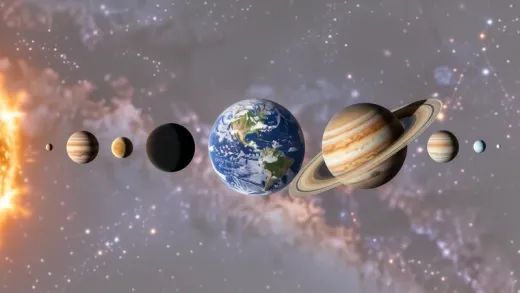
How many planets orbit the sun in second grade lessons
Learn how many planets orbit the sun and discover key facts about the eight official planets, from Mercury to Neptune, for students and educators.