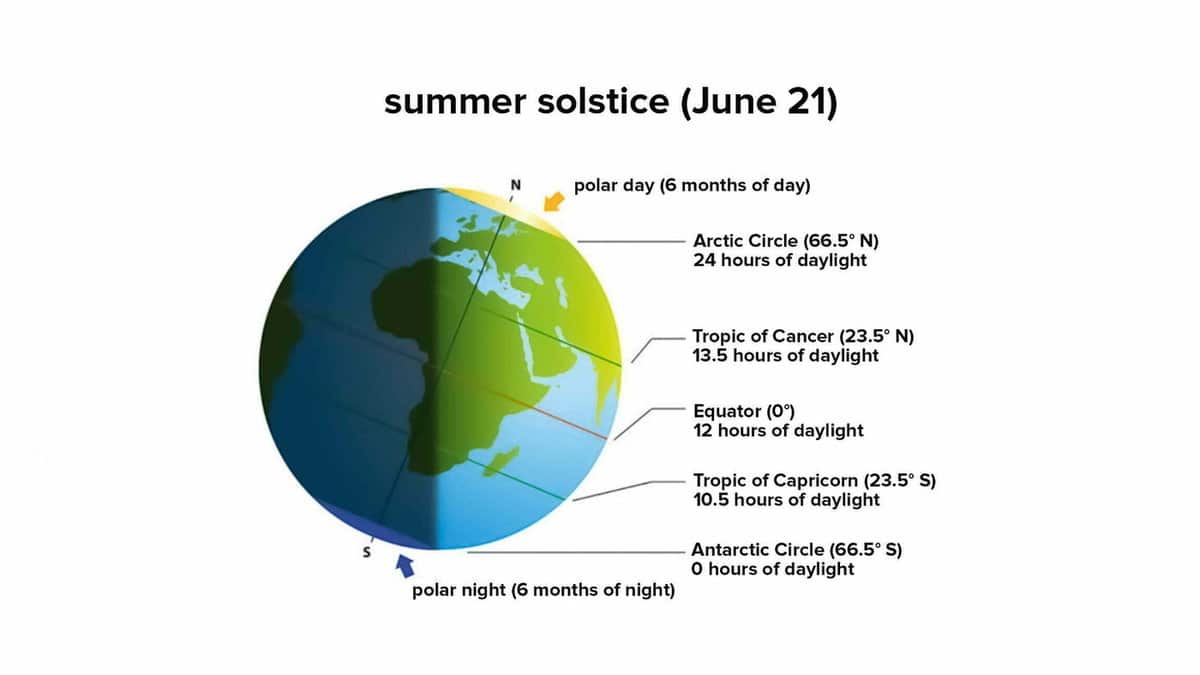

On which parallel is the Sun directly overhead on June 22?
On which parallel is the Sun directly overhead on June 22?

What is the location of the sun at its highest point on June 22?
Where can you find the sun directly overhead on June 22?
Which parallel does the Sun reach its zenith on June 22?
Which parallel does the Sun reach its zenith on June 22?

What is the name of the day when the sun is directly overhead in the southern tropics?
What is the term for the day when the sun is at its highest point in the southern tropics?
The sun is directly overhead the line _________ , at its setting below the horizon across the line ________________________?
The sun is directly above the line _________ , at its setting below the horizon across the line ________________________.

Find out from the calendar the latitude at which the sun is at its zenith in Moscow on the appropriate day.
Find out from the calendar the latitude at which the sun is at its zenith in Moscow on the correct day.
When and where does the sun reach its highest point in the sky during different seasons of the year?
When and where does the sun reach its highest point in the sky during different seasons of the year?
On December 22, where can the sun be found directly overhead?
On December 22, where is the sun positioned at its highest point in the sky?

What is the significance of the sun being at its zenith?
What is the meaning of the sun reaching its zenith?
On what parallel does the sun reach its highest point on October 11?
Which parallel does the sun reach its zenith on October 11?
You have moved on to the question Where is the sun at its highest point on July 22? It belongs to the Geography category, for grades 5 – 9. Here is the answer for the given parameters. If you are not completely satisfied with this answer, you can use the automatic smart search to find other questions on the same topic, in the Geography category. If the answers to similar questions do not fully provide the necessary information, please use the button at the top of the site and rephrase your question. Also on this page, you will be able to see users’ answers.
In this area, there are four distinct climatic zones that run parallel to each other. Due to the influence of the Asian continent, the northern Indian Ocean experiences a monsoon climate, which often brings cyclones towards the coastal areas. You.

In Africa, there are three main races that coexist, with the most prevalent being the Negroid race. This race is particularly dominant in former European colonies such as South Africa.

It is a simple task, here you have it.
The Nelson River is a Canadian river that stretches over 640 kilometers. It originates from Lake Winnipeg and flows into Hudson Bay. It serves as the drainage system for the Bow-Saskatchewan-Nelson lake-river system, covering an area of 1072 thousand km2. The river is known for its rapids, and the average water flow at its mouth is 23 cubic kilometers per year.
Below you can find P. S, which is available on the Internet)).

Indications of stable, clear, precipitation-free weather: – during sunny weather, the temperature drops gradually, the atmospheric pressure rises steadily, and small, jagged cumulus clouds start to form. The wind blows from the northeast or east direction;

14 A 15 B 16 A 17 C 18 B 19 D 20 B 21 Alice 22 Brummie 23 Hawaii 24 dog 25 COP.
© 2000-2023. Reference is required when using materials in whole or in part. 16+
The site is protected by reCAPTCHA technology, to which Google’s Privacy Policy and Terms of Use apply.
Every hunter, mushroom hunter, and tourist are familiar with the compass as the primary tool for determining direction in unfamiliar areas. However, there may be situations where you find yourself without a compass.
In such cases, it is essential for a hunter in an unfamiliar area to be able to determine the direction of the cardinal points using various objects around them, such as celestial bodies, trees, anthills, butterflies, and more.
The most precise method of determining the cardinal points is by using celestial landmarks, such as the sun, moon, and stars.
When the sun is visible in the sky, it is incredibly convenient to utilize it for navigation. If you happen to have a watch with you, the task becomes even easier. To determine the cardinal directions, simply point the hour hand towards the sun.
To achieve a more precise result, place a matchstick perpendicular to the clock in the center of the dial and align its shadow with the hour hand. Once this is done, bisect the angle between the hand and the number 1.
Continuing to mentally extend the line that bisects the angle, we can determine the direction towards the south.
It’s worth noting that before noon, divide the angle by 13 hours, and after noon, divide the angle at which the hand will pass after 13 hours.

Without a sun clock, you can still find the general direction by observing the position of the Sun. During the spring season, the Sun is usually at its highest point around 1 PM in the southern sky. In the morning, it can be found towards the east at around 7 AM, and in the evening, it can be seen towards the west at around 7 PM.
The Sun rises and sets exactly in the east and west only on two specific dates – March 21 and September 23. During summer, the Sun rises in the northeast and sets in the northwest. In winter, it rises in the southeast and sets in the southwest. It’s important to note that during winter, the Sun is never directly in the east or west.
Orienting using the moon
The moon completes a full orbit around the Earth in 27.3 days, and as it does so, it takes different positions in relation to both the Earth and the Sun. As a result, its appearance is constantly changing, leading to what is known as lunar phases.
- There are four primary phases of the Moon:
- 1) New Moon – this phase is not visible in the sky.
- 2) First quarter – during this phase, the moon appears as a semicircle with the convex side facing to the right (referred to as “birth month”). It can be seen in the western side of the sky after sunset.
- 3) Full Moon – this phase occurs when the moon is fully illuminated, and it can be seen from sunset until morning.
- 4) Last quarter – during this phase, the moon appears as a semicircle with the convex side facing to the left (known as “old Moon”). It becomes visible approximately 6 hours before sunrise in the eastern side of the sky.
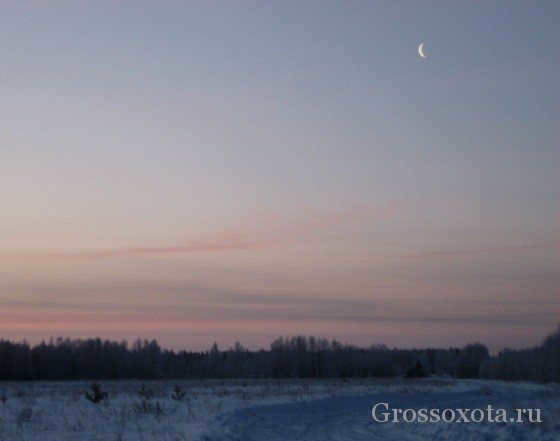
To determine your location using the Moon, it’s important to remember the following: during the first quarter, the Moon is in the southern sky around 7 pm. During the full moon phase, it can be found in the southeast around 10 pm, and at 4 am it will be in the southwest. In the last quarter, it will be in the south around 7 am.
Searching for Polaris in the night sky
This celestial landmark is familiar to almost everyone and is used as a navigational tool on clear nights. Polaris always lies in the northern direction, making it easy to locate. To find it, the first step is to locate the Big Dipper constellation, which resembles a ladle.
The Big Dipper is made up of seven stars and can be seen throughout the year in our country. By using the two outermost stars of the dipper, we can determine the direction to Polaris, which is part of the Little Bear constellation. The Little Bear constellation has a similar shape to the Big Dipper, but is smaller in size.

During the spring season, the Big Dipper can be seen at the zenith, indicating that the Sun is directly overhead at noon. In the summer, the handle of the bucket points towards the west, providing a general direction for orientation. As fall arrives, the constellation is lower in the sky and can be observed in the northern part of the horizon. Finally, in winter, it can be found in the northeast, still low above the horizon.
During a cloudless evening, the celestial phenomenon known as the Milky Way can be easily observed in the atmosphere. This awe-inspiring spectacle is composed of an immense congregation of stars, creating a magnificent ribbon of radiant silver hue.

To utilize this information for orienting oneself on the ground, it is important to bear in mind that the Sun consistently travels from the northern to the southern direction.
Methods of Ground Orientation: Natural Objects, Sun, and Stars
Reliance solely on a GPS system for orientation can prove fatal in emergency situations. Electronic devices may become lost or malfunction, leaving individuals without a reliable means of navigation.
In dense forests or during severe weather conditions, GPS devices may struggle to establish satellite connections, hindering terrain orientation efforts.
Furthermore, in areas without street names, even knowing your exact coordinates will not be helpful if you lack recognizable topographical landmarks.
It is crucial to be prepared by carrying a compass, extra batteries, and a backup map. Prior to venturing into unpopulated regions, study the area on a map.
Familiarize yourself with the features within a 20-30 kilometer radius of your destination to ensure a successful journey.
If you find yourself disoriented, you can use the position of certain natural elements like lakes, villages, mountains, and the seashore to regain your bearings.
Whether it’s intentional or not, nature provides observant individuals with numerous hints about their whereabouts. As the majority of winds come from the west, trees and bushes typically have denser foliage on their eastern side. Additionally, there tend to be more branches on the southern side, as it receives the most sunlight due to the Earth’s tilt.

Moss, on the contrary, thrives in shaded areas and is typically found more frequently on the northern side of trees. It is important to exercise caution when using this particular clue, as a tree may be shaded by surrounding trees. Like any other clue, it is crucial to consider the overall context and avoid making hasty assumptions.
Using the Sun to Navigate
While satellite tracking is a relatively new technology that has greatly impacted our lives, humans have been using celestial objects for navigation purposes for thousands of years. If you are familiar with a map and have a general understanding of the terrain, you can rely on the Sun, our closest star, to guide you to safety. Simply observe its movement and you will be able to orient yourself in the area.

The most convenient way to monitor the movement of the sun is to establish the direction in which your shadow is cast. As the sun rises in the east, it casts its shadow towards the west in the morning. As the sun starts to move west in the afternoon, your shadow will point towards the east. However, at noon, when the sun is directly overhead, it creates very little shadow, making this technique challenging to use.
However, if you have an analog clock, you possess all the necessary tools to determine the cardinal directions (north, south, east, and west).
Raise your hand with the clock as if you were about to read the time, and then rotate it so that the hour hand “faces” the sun.
The direction south corresponds to the spot on the watch that lies between the hour hand and the 12 o’clock marker.
If you find it difficult to determine the current time, try creating an impromptu sundial and utilize the motion of your own shadow to establish your orientation. To accomplish this, simply insert a stick into the ground and position a rock at the spot where the shadow of the stick concludes.
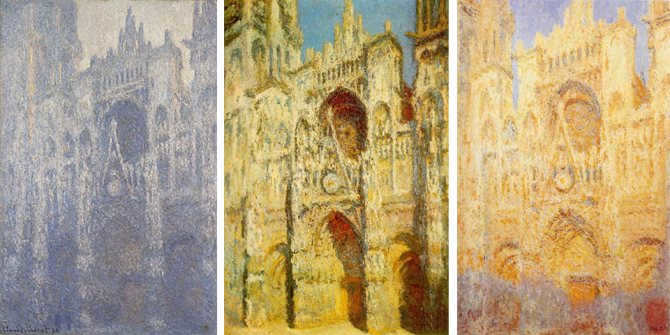


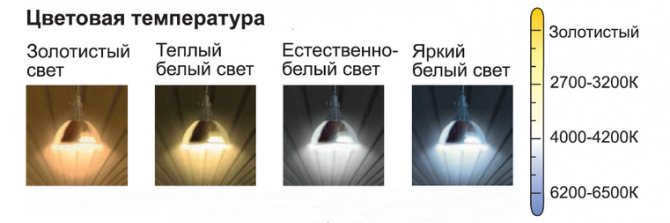
This situation is not very common, but it is still possible. Let’s examine the artwork of Dean Cornwell. The individuals depicted in the painting and the backdrop behind them are bathed in a chilly, greenish glow, with hints of cozy brown tones peeking through the shadows.

The scene is given an unsettling atmosphere by the cold green light.
In a regular room with warm-colored interior and windows facing north, a similar effect of “warm shadows – cold light” can be observed. Warm shadows will be created by secondary light sources reflected from the walls, floor, and furniture, while the light coming from the north-facing window will have a bluish and cold tone. Swedish artist Anders Zorn painted his wife Emma under such circumstances:

White cool light illuminates the model’s face, while the shadows are composed of a combination of deep red and ochre tones.
Another instance of a painting featuring a intricate lighting arrangement is Lunch on the Boat by Joaquin Sorolla. The scene includes multiple sources of light. On the boat, we observe numerous reflections; the light filters through a sail draped over the mast, casting a glow on the boat. The focal area creates a warm shadow, which provides a striking contrast to the cool sunlight outside.

Within the shaded area, the planes reflect light in various ways: those looking upwards receive a greater amount of warm yellow light compared to those facing sideways and downwards.
Orienting oneself locally using the sun on the SearchPath website
No matter where you find yourself, it is crucial to be aware of all possible methods of orienting yourself in the surrounding terrain, both through specialized devices and natural indicators. Modern technology, such as navigation systems, is prone to malfunctions and cannot always guarantee accurate navigation.
Furthermore, our country has numerous settlements, villages, and other locations on the map with the same names.
The most important thing, in case you become lost, is to remain calm, regain control, and attempt to utilize your knowledge of orienting yourself in the terrain using the sun, moon, stars, and other natural indicators.
Using the sun for orienting oneself on the terrain
It is common knowledge that the sun rises in the east and moves towards the south during the day, eventually setting in the west. During nighttime, the moon takes over, while the sun “rests” in the north.
The higher the sun is in the sky, the shorter the shadows will be. Typically, the sun reaches its highest point around noon. By observing the direction of the shadows, one can determine where north is. It is worth noting that this method is only applicable between the North Pole and the Northern Tropic. If you find yourself in the southern hemisphere, the shadows will point towards the south.
In the Northern Hemisphere, one can easily determine the cardinal directions based on the position of the Sun’s shadow. The general rule is to stand facing the Sun at noon. By doing so, you will be facing south, while the shadow cast will indicate north. West will be to your right, and east will be to your left.
How can one determine the directions of the horizon using a clock? To accomplish this, position the clock so that the hour hand aligns with the Sun’s location, pointing towards it. The angle formed between the hour hands should be divided in half, visually drawing a line that bisects it. This line will represent the true noon of the area.
By following this method, you will be able to identify the locations of south and north. However, it is important to know the exact time of noon at your specific location in order to accurately determine the cardinal directions.
Determining local time and directions around the world using a gnomon
To determine the position of the Sun in the southern hemisphere, one must identify the shortest shadow. By identifying this position, it is possible to accurately determine true noon during that time period. This moment can also be determined using a simple device known as a gnomon.
On a sunny day, a small pole or stake, measuring up to 1.5 meters in height, is inserted into the ground. The shadows cast by the pole are then observed at different times, and their lengths are noted. The shortest shadow will indicate the direction south.
A tree or any vertical object standing on the ground can be used as a gnomon.
Orienteering using the sun and stars
Navigation at night becomes much simpler than during the day, provided that the sky is clear and the stars are visible. To navigate on the ground, one must locate the brightest stars that form a constellation resembling a bucket with a handle, known as the Big Dipper. By doing so, it becomes effortless to locate the Little Dipper and Polaris, which is situated at the tail of the latter constellation.
In order to determine the direction of the northern side, one must connect the two outermost stars of the Big Dipper and measure a distance that is five times the length of the resulting line segment. The direction towards Polaris will perfectly align with the meridian, and if a straight line is drawn downwards from it at a 90-degree angle to the Earth’s surface, it will indicate the north.
Also, check out: What to use for sheltering a fisherman from inclement weather, whether it’s a raincoat, umbrella, or awning?
Moon-based Orientation
Scientific research has demonstrated that during a full moon, one can orient themselves using the moon in a similar manner as they would with the sun. For example, at 01:00, the moon will indicate the southward direction, while closer to 7:00, it will be in the western sky, and at 19:00, it will be in the eastern sky.
The waxing moon consistently follows the sun with a slight delay. When the waxing moon is at its halfway point, it is precisely 90 degrees behind the sun. This means that at 19:00, the halfway point of the waxing moon will indicate the south, and at 1:00, it will indicate the west.
Conversely, the waning (or aging) moon is approximately 90% ahead of the sun.
In order to find the solution to this query, we will examine the most basic geometric shape. Our focus will be on a cube, as it is the starting point for learning academic drawing, thanks to its straightforward and comprehensible structure.
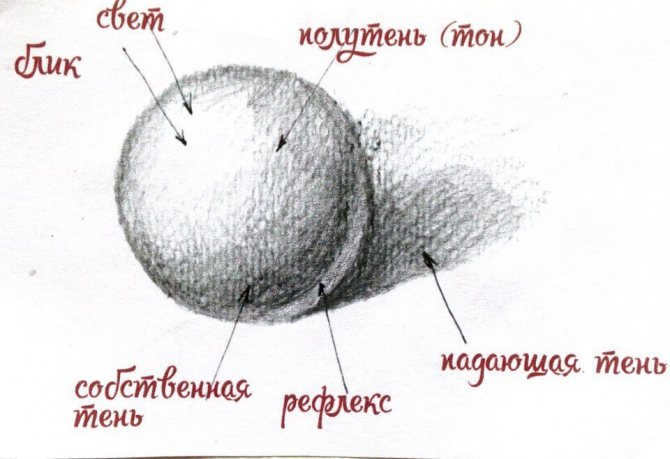
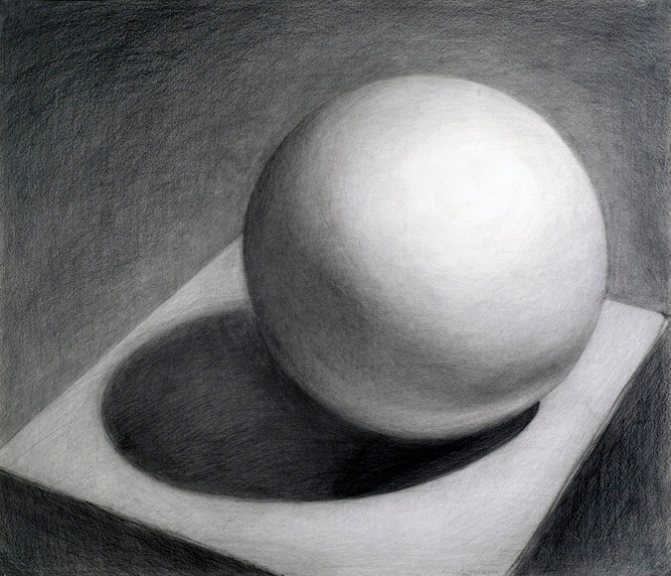
To create an accurate depiction of a falling shadow, we adhere to the following procedure.
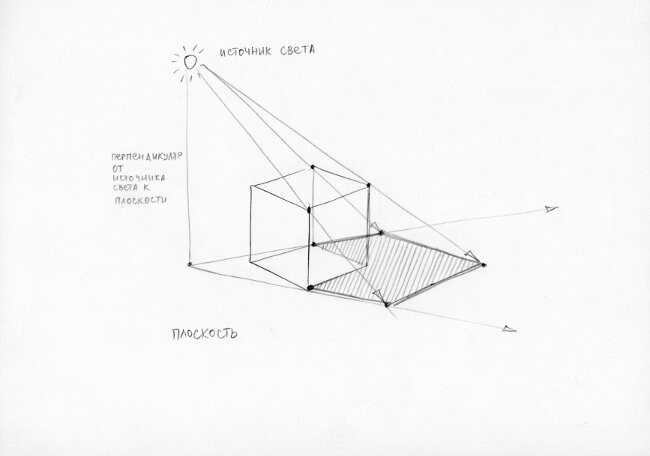
- Identify the origin of the light. There may be multiple sources of light (such as a lamp and daylight from a window). For now, let’s assume there is only one source.
- Create a perpendicular line from the point of illumination to the surface where the object is situated.
- Draw straight lines from this perpendicular line to the points on the object.
- Sketch lines that extend from the light source to the points on the cube.
- Indicate the points of intersection for all the rays. The lines should be distinct and evenly drawn to ensure clear visibility of the intersection points.
- Connect the intersection points to form a plane. This plane represents the cast shadow.
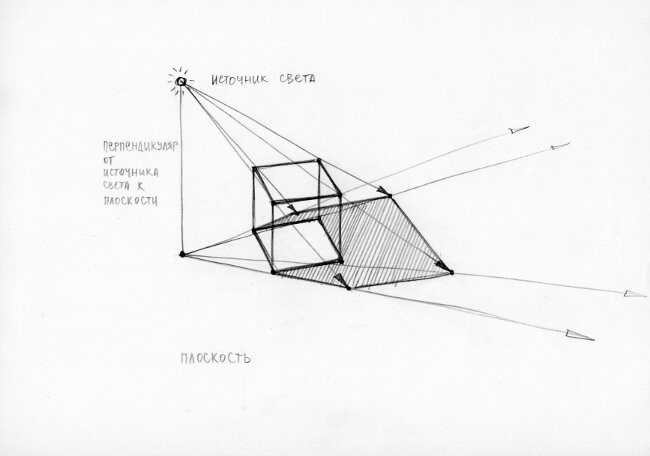
When constructing an object, these steps are carried out automatically during practice. It is important to keep in mind that the sun may not always be directly overhead, so developing spatial thinking is necessary. This skill will aid in mentally tracing the path of the rays.
This principle applies to all objects, although the shape of the shadow may vary depending on the object.
![Exact time of obligatory namaz in Chelyabinsk [current_date format='d F, Y'], today: morning, evening, afternoon](/wp-content/uploads/images/gde-nahoditsja-solnce-v-zenite_29.jpg)
In the article When the Sun Reaches Its Highest Point, you will discover what this phenomenon is, how it occurs, and what unique characteristics it possesses. We will delve into how the Sun reaches its highest point in various regions of the world, the impact it has on nature, and how people incorporate this phenomenon into their daily routines. If you desire to grasp the significance of the brightest and hottest moment of the day, then this article is tailored for you!
The Sun plays a significant role in sustaining life on Earth. Its light and warmth are vital for the existence of life on the planet. However, when the Sun reaches its zenith, its influence on life on Earth surpasses any other period.
The point in the sky directly above the observer is known as the zenith. When the Sun is at its zenith, it is directly overhead. This occurs twice a year during the tropics’ solstice. During this time, the Sun is positioned above the equator and shines straight down.
The impact of the Sun’s zenith on Earth’s life can vary depending on the location. Climatic conditions can change, affecting both animals and plants. In certain areas, the Sun’s zenith can lead to flooding or land slumps. Additionally, the risk of sunburn and heatstroke significantly increases during this time.
However, in cultures where the zenith is associated with religious or traditional rituals, it may be seen as a holiday. Overall, the Sun’s zenith can have positive and negative effects on Earth’s life, and its specific conditions and location should be taken into account.
Zenith represents the exact position in the sky directly above the observer’s head. When gazing upwards, the zenith is the point where the sky appears to converge into a single point. The term “zenith” originated from the Arabic word “as-samt,” which translates to “center.”
To determine the zenith, we utilize a device known as a circular. This apparatus consists of a vertical rod and a horizontal plane on which the rod is lowered. The circular is positioned at the station or equator, aligning the horizontal plane with the geographic latitude. The observer then rotates the rod until it aligns with the zenith, pointing directly upwards. The angle formed between the zenith and the horizontal plane is measured and referred to as the zenith angle.
The zenith angle plays a crucial role in navigation and geodesy, serving as a key indicator of the elevation of the Sun, stars, and other celestial bodies above the horizon. It is extensively utilized in calculating the precise geographic coordinates of an observation site.
The Impact of Zenith on Earth’s Life: Climate and Biology
Zenith refers to the moment when the Sun is directly overhead from the perspective of an observer. At the equator, this phenomenon occurs twice a year, during the solstices. On these particular days, the Earth receives the maximum amount of heat and light from the Sun, thereby exerting a significant influence on the climate and biological processes on our planet.
Climate. The position of the Sun at its highest point in the sky, known as the zenith, plays a significant role in shaping the Earth’s climate. When the Sun is directly overhead, it illuminates the areas near the equator, which experience the highest levels of heat and humidity. This intense energy from the Sun triggers the formation of massive air currents that transport moisture and warmth towards the north and south, resulting in the creation of diverse climate zones.
Biology. The zenith of the Sun exerts a profound influence on the metabolic processes of living organisms. This effect is particularly noticeable in the realm of plants, as they respond to the Sun’s zenith by accelerating their growth, hastening the onset of flowering, and ultimately yielding bountiful harvests that positively impact the economy.
- The zenith of the Sun is a potent natural phenomenon that profoundly influences life on Earth.
- Living organisms experience accelerated metabolic processes under the influence of the Sun’s zenith.
- The position of the Sun at its highest point in the sky has a significant impact on the Earth’s climate.
- When the Sun reaches its zenith, it is directly above the regions of the Earth that are located near the equator.
Q&A:
Q: How is the time of the Sun’s zenith determined?
The time at which the Sun reaches its zenith is determined by a combination of factors including the specific geographic location, latitude and longitude, as well as the current date and time.
Question: In which areas is it possible to observe the Sun at its zenith?
Observing the Sun at its zenith is only possible in the tropical regions, between the Tropic of Cancer and the Tropic of Capricorn. This specific area is known as the zenith zone.
Q: When does the Sun reach its zenith?
The Sun reaches its zenith at different times of the year depending on the location. In the northern hemisphere, it occurs twice a year – in March and September, while in the southern hemisphere, it happens in December and January.
The position of the Sun at its highest point in the sky has a significant influence on the biodiversity of our planet. Take, for instance, the impact it has on photosynthesis – when the Sun reaches its zenith, the rate of this vital process rises, leading to enhanced plant development. Moreover, various animal species exhibit heightened activity levels during this period, coinciding with zenith, and are also influenced by the weather changes that accompany it, such as the phenomenon of bird migration.
How does an overall disruption of zenith light impact human well-being?
A deficiency in zenithal light can result in significant health issues, including depression, insomnia, emotional turmoil, and muscle discomfort, among others. However, an excessive amount of zenithal light can also have detrimental effects, making it imperative to maintain a balanced and mindful approach to sun exposure.
Q: How can I safeguard myself against overhead light?
There are several measures you can take to shield yourself from zenithal light, such as applying sunscreen, donning a cap or hat, using protective sunglasses, refraining from sun exposure during peak light hours, and so on.
Q: What precautions should be taken when spending time in the sun at its highest point?
When the sun is at its zenith, it is highly advisable to minimize the amount of time spent under its rays, particularly during the midday period when the sun’s radiation is at its strongest. It is essential to utilize appropriate protective gear, stay hydrated, and refrain from engaging in strenuous activities while exposed to the sun.
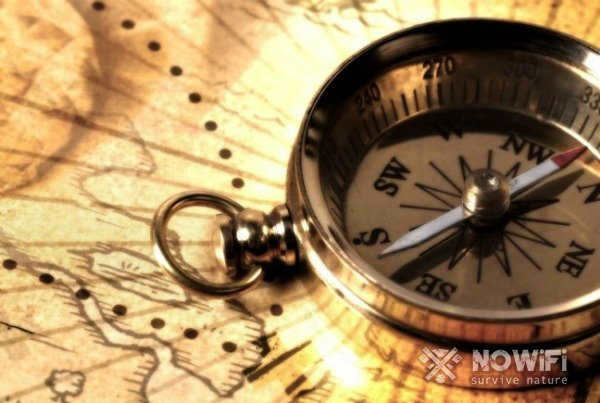
Nowadays, we have become so reliant on modern conveniences and technological gadgets to navigate our way through the world. Many people don’t even know how to determine the cardinal directions without the help of a GPS or smartphone. These devices have, in a way, disconnected us from nature. However, when it comes to activities like hiking or finding our way out of a dense forest, these gadgets become useless. In such situations, the knowledge we gained in our geography classes comes to our rescue. And if we’re lucky enough to have a compass with us, it makes things even easier. But what if we don’t have any of these tools? In this article, we will explore some methods to determine the directions of north, east, west, and south without any aids at our disposal.
Ways to ascertain the cardinal directions
The cardinal directions on the horizon are interrelated, so if you are aware of one of them, it is not challenging to determine the others. For instance, if you are aware of the location of the north, then the opposite direction would be the south, the left side would be west, and the right side would be east.
There is a conceptual line known as the noon line that runs from north to south and serves as the primary reference point for many explorers.
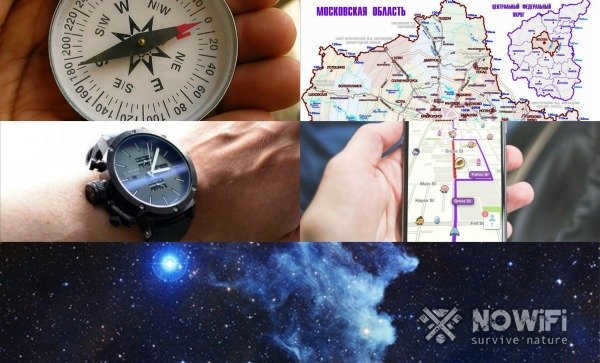
Ways to Determine the Four Cardinal Directions (Figure 1):
- You can use a compass or map to find your bearings;
- Identify your direction by landmarks in your local area;
- Observe the movement of the sun and stars in the sky;
- Utilize modern technological devices;
- Refer to a wristwatch for assistance.
Let’s Review Our Knowledge of Geography:
- The north and south coordinates are determined by the Earth’s poles;
- The east and west coordinates are based on the planet’s rotation around its axis;
- Therefore, the latter can be determined by the apparent sunrise and sunset.
There are numerous methods to ascertain the four cardinal directions that are effective, even when lacking any tools, all of which are associated with natural objects, albeit not always dependable.
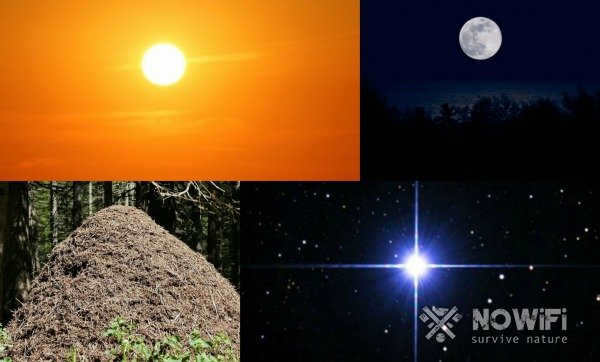
There are several ways to determine the sides of the world (Figure 2):
- Using the position of the sun, moon, and stars;
- By observing the length of shadows and the polar star;
- By looking at anthills and trees, as well as the presence of moss.
There are no doubts about the route when using this particular object (Figure 3).
Now, let us explore how to determine the positions of the world’s sides with the help of this object:
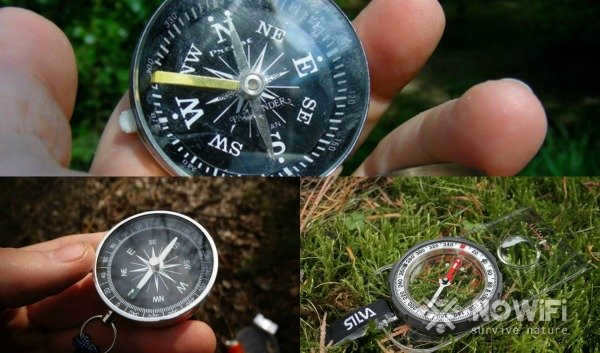
- To determine the position of the sun at its zenith, find a suitable location away from power lines, highways, and railroads;
- Release the compass needle and place the device horizontally, carefully rotating it;
- Wait until the oscillating needle comes to a stop, with its long (blue) end pointing towards N, which stands for north, and its small (red) end pointing towards S, which stands for south;
- If you are facing north, the direction to your left is west (W), and the direction to your right is east (E);
- Select a desired route and a significant landmark in one of the identified directions, and start moving towards your destination.
Ways to Determine Cardinal Directions without a Compass
When finding oneself in an unfamiliar location, the first step is to establish one’s bearings and determine the cardinal directions.
To accomplish this, it is essential to understand various methods of determining the sides of the world without relying on a compass:
- The position of the North can be determined by locating the Polar Star in the sky;
- In the Southern Hemisphere, the Southern Cross serves as a reference point for the South;
- The southern direction can also be determined by observing the position of the Sun and using a hand clock;
- If the Moon is clearly visible in the sky, it can also be used as a guide;
- Natural indicators such as lichens and mosses, resin from coniferous trees, the presence of growing mushrooms, and anthills can also provide clues.
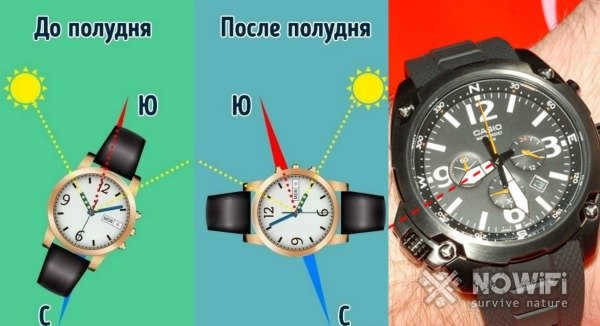
Let’s consider a straightforward algorithm for determining the cardinal directions using a clock:
- Keep in mind that in the northern hemisphere, the Sun is in the east at 7 am, in the south at 1 pm, and in the west at 7 pm;
- Similar to a compass, place the clock horizontally and rotate it so that the hour hand points towards the Sun;
- The resulting angle between the hour hand and the number one is divided in half, creating a line that indicates the South direction, and its opposite direction represents the North (Figure 4);
- Note that before noon, the arc that the hour hand needs to travel to reach 1:00 pm is divided in half, and after noon, the arc that the hour hand needs to travel after that time is also divided in half.
At the break of day and the fall of night
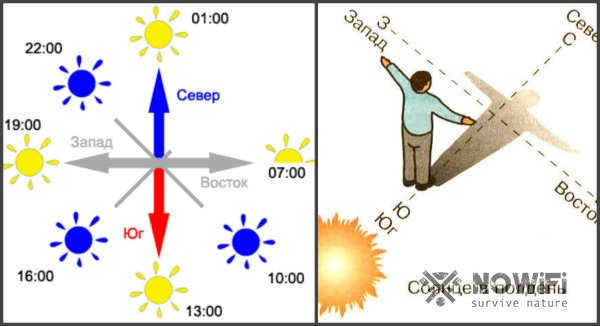
The technique for determining the cardinal directions using the sun is based on the following:
- The sun rises in the east and sets in the west (Figure 5);
- Next, position yourself facing a geographical map;
- Extend your right hand towards the sunrise, which indicates the location of the East;
- Extend your left hand towards the sunset, which indicates the location of the West;
- By doing so, you will be facing the North, and the South will be behind you.
By measuring the shadow’s length
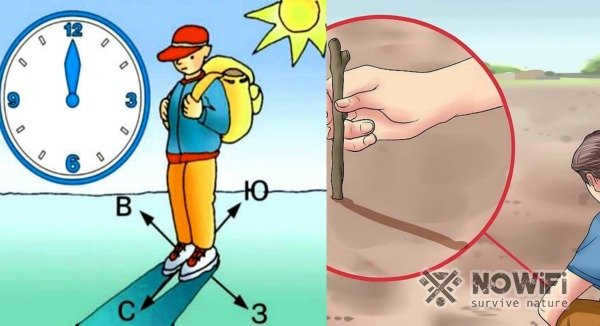
This technique for determining the orientation of the earth’s sides is based on observations of the sun:
- When the sun is at its highest point, known as the zenith, it indicates the south direction;
- Conversely, the north direction is at the opposite end, with east and west on the sides (see Figure 6);
- You can determine when the sun is at its zenith by observing the shadows cast by objects;
- If the sun is at its peak, the shadows will be as short as possible;
- To accomplish this, measure the shadows throughout the day using a tree or stick;
- Identify the smallest shadow, and its endpoint will reveal the north direction.
Using a needle
If you are familiar with the concept of a compass but do not have one at your disposal, you can still find your way using a magnetized needle. Creating a magnetized needle is a simple process – all you need to do is quickly stroke it with a pair of metal scissors. You will also need a few additional items – a container filled with water and a piece of foam or cork. If these items are not available, you can lubricate the needle with vegetable oil to help it float on the water’s surface.
Using this method to determine the cardinal directions does have one significant drawback – it can only help you identify the north-south line.
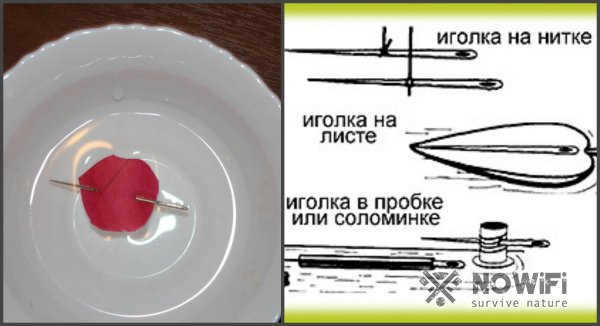
Using a needle to determine the direction of the world:
- Take a needle and stick it in a cork or grease it, then place it on the water (Figure 7);
- Almost immediately, the needle will align itself in the North-South direction;
- To determine where South and North are, additional steps will be required.
Using the position of Polaris
As the Earth spins, Polaris remains fixed in the sky, making it an excellent reference point. It is consistently found near the North Pole.
Let’s explore how we can use it to determine directions:
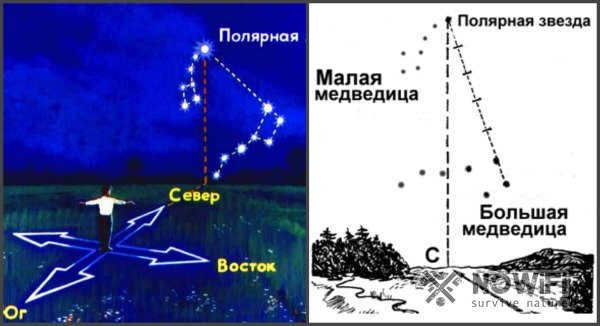
- To begin, locate the handle of the Big Dipper in the sky;
- Visually trace a line through the two stars that make up the opposite side of the dipper;
- If you extend the line further, it will intersect with the alpha star of the Little Dipper;
- This star is known as Polaris, which signifies the north direction;
- Orient yourself so that Polaris is in front of you; with south behind you, east to your right, and west to your left (Figure 8).
Utilizing natural objects
This method of determining cardinal directions is often regarded as the least dependable, but in situations where other alternatives are unavailable, it becomes necessary to rely on what is at hand.
Orientation by natural objects:
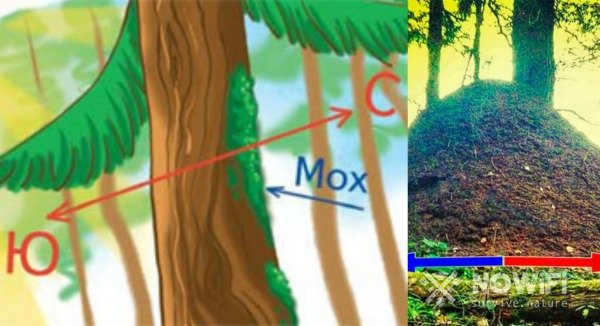
Back in school, we were taught that moss and lichen tend to grow more on the northern side of solitary stones and trees, and the slope of an anthill is steeper from that direction (Figure 9).
However, in practice, these external signs can be influenced by various factors such as wind, the presence of water sources, darkness, and terrain features.
As for forest objects, it is true that there are more red barrels of cowberry and strawberry berries in the southern part, and the corollas of successionberry turn towards the sun, but these signs are only true statically.
It is better to use orientation by these objects in conjunction with other methods.
Discovering the Directions of the World using Modern Technological Methods
It is common knowledge that computer programs and mobile apps can efficiently accomplish this task. Moreover, it is even easier to determine the directions of the world online.
Let’s take a look at a few examples:
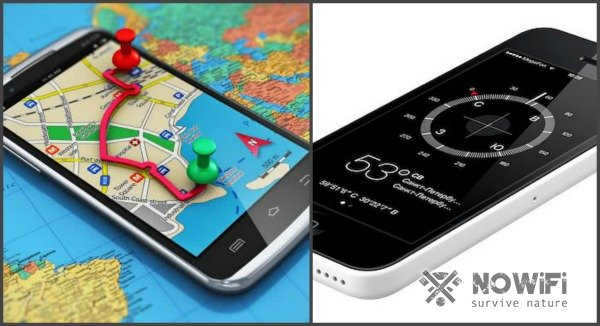
- In today’s era, modern smartphones are often equipped with a built-in compass. However, if you want to have additional functionality, you can install a java applet called Compass, which can determine directions based on the position of the sun;
- Many other applications work on a similar principle. They gather information about the hemispheres you are located in, utilize the current time, and create an intersection between the north-south and west-east directions on the screen. As a result, the mobile device simply needs to align itself with the sun’s position, causing the drawn crosshairs to align with the real ones;
- Furthermore, most smartphone models offer excellent support for GPS navigation. By uploading a GPS map, you can always rely on accurate directions for your travels (Figure 10);
- Having a separate item like a pocket GPS navigator can be a lifesaver during hiking trips. It eliminates the need to constantly search for directions and ensures you never lose your way. Nowadays, this incredibly useful tool is not only available as a standalone device but also as a built-in program in cell phones and cars.
Methods of Identifying Cardinal Directions on an Online Map
Techniques for Identifying Cardinal Directions on a Map (Figure 11):
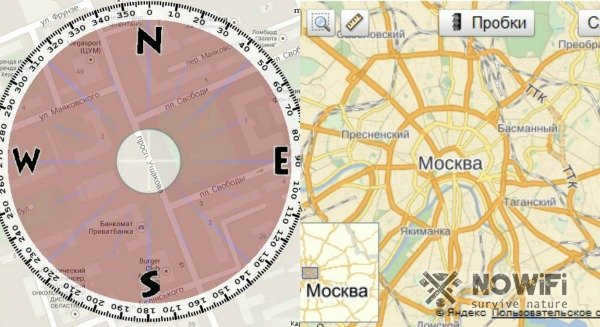
- Utilize a standard Google Maps platform to access a comprehensive view of intricate details in high resolution;
- If you desire to determine the geographical positioning of a specific structure in relation to your current location, simply locate both on the map;
- The map will automatically align itself in accordance with the traditional cardinal directions – top corresponds to north, bottom corresponds to south, left corresponds to west, and right corresponds to east;
- This same principle applies to other mapping programs such as 2Gis, Yandex Maps, and similar platforms.
Determine the orientation of a house using online services
Many people are curious about how to determine the orientation of their apartment.
There are a few reliable methods to do this:
- Observe the natural surroundings – take note of where the sun rises and sets to identify the directions of east and west;
- Utilize a compass – stand in the center of the room and hold the compass horizontally, making sure the needle points towards the north;
- Access online mapping services and input your location;
- If you have a wristwatch with a built-in compass, use that;
- As a last resort, ask your neighbors for assistance.
Alternatively, you can opt for a more modern approach – determine the orientation of your apartment using an online compass:
- Most of these resources function properly with the Google Chrome browser;
- Launch a search engine and choose any of these services;
- You will see a large compass on the map background with N, S, E, W markings;
- Locate your city and house on the map, and based on the image, you will determine the direction your windows are facing.
More advanced online services offer the ability to determine the cardinal directions by simply entering your apartment address in the search box. These services can be useful if you have access to wi-fi or mobile internet, whether you want to use them at your country house or in the city.